05 juin 2006

Arts & citizenship: Do cities have a soul? Does Brussels have a soul?


Thom Mayne, north-american architect who won the Pritzker architecture Prize in 2005, asks himself the question in an interview displayed at the "Morphosis" exhibition, @ the Pompidou Centre in Paris.

The
exhibition is a 250 sqm showcase, a horizontal screen on which one walks, revealing at our feet a view of 16 recent projects (lay-outs, drawings, photographs, etc.) from the Morphosis agency, currently involved in the construction of numerous buildings, to convey the idea of architecture "in the act". Morphosis is an architecture agency based in Los Angeles (actually Santa Monica) founded by Thom Mayne in 1972 (4 years only after graduating in 1968). The display was designed by the agency and takes us back to contemporary myths of L.A. as illustrated by its cinematographic and photographic images. It includes some interviews and documentaries about Thom Mayne and his work.

Moving away from traditional architecture, urbanism and town planning seen as independent disciplines, Morphosis focuses on a cross-cutting multi-disciplinary approach of relationships between the individual, space, territory and the institutional setting. "The designers reaffirm the capacity of architecture to invent its own controls and organizational models following examples provided by biology and computing".

Morphosis started a new phase around 1993, with the book "Connected Isolation" which laid down the basis of Thom Mayne's theoretical language. Even though the agency remained modest in size (around 40 collaborators) some big projects have been developped, including urban interventions, works for the american public administration, etc, as is the case of the Sun Tower in Seoul (1994-1997) and the Diamond Ranch College at Pomona (California, 1999) which marked international recognition for Mayne's work. Nowadays awards and contracts keep growing for ever bigger and more important works such as the Federal Building in San Francisco, the Court of Justice building in Eugene (Oregon), the Caltrans District 7 building in L.A. the Hypo Bank Alpe-Adria in Austria or the social housing complex in Carabanchel, Madrid. Morphosis understands its arena of operation to be one marked by contradiction, conflict, change, and dynamism.

Thom Mayne's and Morphosis' work have certainly contributed to re-shape urbanism and architecture in L.A. and beyond. With their creativity and approach they have contributed (together with other architects) to the recent mutation and dynamism in the californian metropolis. They do not see architecture as the creation of isolated works of art but rather as solutions for human problems in a fast changing world. As Mayne puts it "architecture should help to live in society", and therefore contribute to intensifying social contacts. Mayne has devoted part of his work to the creation of public spaces which can contribute to make a city like L. A. more "human" and attractive. However as he says, the creation of public spaces alone does not mean that people will start to interact more easily. As Mayne puts it, the geography of human relations is complex and modern cities do not work anymore as the previous "villages" in Europe. People do not relate necessarily to their immediate neighbours but live in multi-layered webs of relationships in the global village. Modern cities should adapt to the new models. It is all part of a process whose dynamics are difficult to master and foresee. Mayne seems in any way very aware about the challenges of modern societies and of the difficulties for the future (energetic, social disparities, economic, etc) claiming that architecture and urbanism will have to adapt and reflect the changing world, bringing new solutions and alternatives.

I consider that the creation of public spaces is an interesting and important issue and makes me go back to the initial question "do cities have a soul" ? This is not an easy question to answer, which city do we want to live in? Which is the best model? The answers are differentiated according to the context and diversity is essencial. But it is true that urbanisation has increased throughout the world and people live more and more in and around large urban centers, which have become more and more attractive. Yet, at the same time, sometimes more difficult to live in. Whether we pursue the model of a big city with a multitude of smaller-village communities or the L.A. model or something in between, public spaces can play an important role and can also contribute to increase the attractiveness of a city for living, for doing business or simply to visit. Some cities have been able to create such spaces - Paris with the Pompidou and The Halles area, the Louvre area, the La Vilette complex (among others), London with the new Tate gallery or Covent Garden, Madrid around the Reina Sofia Center, Barcelona with the Port Olimpic or the Maremagnum area, Berlin with the Sony Center and the area around Brandenburg, Lisbon with the Belem Cultural center, Copenhagen with the Black Diamond library, Amsterdam with the Museum area, or other urban cultural equipment works (the Guggenheim in Bilbao) and many others, not only in Europe but also in the US. These experiences are not all equal, some are more cultural, others more commercial, some may have been more successful than others yet they all share similar objectives. They can and have contributed to improve urban life quality and thus can play a central role in metropolitan areas.

However, Brussels, city pretending to be the capital of Europe, has seen no public (nor public-private) investments in this area in the last 25 or more years. Where is in Brussels any public space where cultural and social activities take space? Which brings people together? A place where exhibitions, performances, shows, can take place, where people can meet and interact? The Palais des Beaux Arts? Too small. The
Botanique? Too small. The music city around Tours & taxis? how long before anything will develop there? It simply DOES NOT exist. And Brussels could well create such a public space (there is NO place in this city where a large exhibition can take place), a place dedicated to Europe's cultures, arts and languages. A place which could display european artists (and others!), to come present their work, their art. A place to celebrate culture and diversity. Brussels owes this well to the europeans. And Brussels disposes of excellent architecture and urban possibilities which can be developped. After benefiting economically hugely from the presence of European institutions (and all business around it) it is about time the city gives its inhabitants and Europeans something back. To improve quality of life in the city, as well as its image. What about a plan to improve the public areas around the european institutions, for instance? Yet where is also the initiative from European institutions? NONE! But please, do not follow the usual slow belgian pace (not like the Music Instrument museum which took nearly 10 years to see the light), and spare us the complicated intercomunity struggles. I mean now! I do not mean pharaonic huge projects, does not need to be that, but human scale projects. This city needs projects, ideas, a new soul, not denying its present "soul" if any, but enlarging it, enriching it. And making it more human. More universal.

EXPO - Los Angeles 1955-1985 : Naissance d’une capitale artistique


Le Centre Pompidou à Paris présente cette exposition consacrée à la scène artistique de la ville californienne. L.A. surprend par la diversité et créativité de sa scène artistique, marquée par un renouvellement continu des esthétiques et des artistes. L’art reflète la complexité de cette ville cosmopolite et s'y développe de la culture californienne au cinéma hollywoodien, des mouvements underground au Disneyland. La scène locale s'est affirmée comme une force alternative à la situation new-yorkaise et a attiré des artistes d'origines diverses. L'exposition s'attache à montrer l'importance et la spécificité d'un contexte artistique qui reste à découvrir.

A travers une large sélection de peintures, sculptures, installations, photographies, films et vidéos, l’exposition retrace l'histoire de cette scène particulière, depuis son émergence au milieu des années cinquante jusqu'en 1985 [pourquoi seulement?]. Elle montre notamment les recherches de l'art de l'assemblage, du Pop art, de l'architecture, du Minimalisme californien, du mouvement "Light and Space", de l'art conceptuel, de la performance, etc, au travers d'une sélection de 85 artistes environ. Certains artistes exposés ont une renommée internationale comme Ed Kienholz, Allan Kaprow, Ed Ruscha, James Turrell, John Baldessari ou David Hosckney, d’autres sont moins connus du public européen. A voir!

02 juin 2006

Citizenship: leading role for women in Finland

Article in BBC website celebrates one hundred years that Finnish women became the first in the world to have unrestricted rights both to vote and to stand for parliament. In the elections in the following year, that is, 1907, 19 female Members of Parliament (MP) were elected and women have continued to play a central role in the nation's politics ever since. But it would be only 22 years before the UK and 38 years before France gave women the vote and 65 years before Switzerland followed (in 1971, while some cantons only in the nineties!).

In Finland this year, Tarja Halonen was re-elected president and women play a central role in national politics and in government, they also have a high employment rate and an important participation in the economy. The same is valid for Norway and for the other Scandinavian countries. But this is only the result of a long-standing cultural tradition of gender equality.

Among the 6 top countries with higher percentage of women in the national parliaments in the world (or lower Houses) we find the four Scandinavian countries (Sweden 45.3%, Norway 37.9%, Finland 37.5% and Denmark 36.9%). The other two are Rwanda (48.8%) and Costa Rica (38.6%). Most European countries do quite well, in particular Spain has improved a lot (36%) in the most recent elections, but some countries are still shamelessly lagging behind, such as the UK (19.7%) Greece and Ireland (13%), France (only 12.2%!) and Italy, which is the worst performer in the EU, with only 11.5% of parliamentary seats filled by women. Portugal doesn't do too bad with 21.3%. Outside Europe, Argentina sets the example (35%) but the USA (15.2%) and Japan (9%) are among the worst performers.

This picture is similar for
participation in governments (as well as for other areas of economic and social life) where women still have great difficulties in "imposing" themselves in the "men's world". However things have recently been changing also in other areas of the world (not only in Europe), like in Africa where women have become government leaders (Liberia, Mozambique) or in Southern America (Chile). Several countries have recently elected their first female leader - Liberia, Chile and Germany among them - and women in Kuwait are preparing to vote and stand in parliamentary elections for the first time later this month. This is quite important, knowing how difficult it usually is for women to participate activilely in economic and social life in arab cultures.

Some countries are also introducing "positive discrimination" rules, as Portugal has recently done, to ensure that more women come into politics, parliaments and governments. Following the trend, women should also come more to leading positions in firms, in the private sector.

01 juin 2006

Le temps / the weather

Think well before coming to Belgium, these days, you may wish to avoid Brussels. Today, a fortnight before the official beginning of summer, the temperatures vary between 5°C and 11°C, with rain. / Réfléchissez bien avant de venir en Belgique, ces jours-ci il vaut peut être mieux éviter Bruxelles. Aujourd'hui 1er juin, à une vingtaine de jours de l'Eté, les températures varient entre 5°C et 11°C. / Pense bem antes de vir à Bélgica, por estas alturas é talvez melhor evitar Bruxelas. Hoje, a escassos vinte dias do Verão, as temperaturas oscilam entre 5°C e 11°C, com chuva, muita chuva...

[It seems that the 1st of June 2006 was the coldest in Belgium since 1830... and they dare talking about global warming... / Il semble que le 1er juin 2006 a été le plus froid depuis 1830... et ils osent parler de réchauffement de la planète! / Parece que foi o 1 de Junho mais frio desde 1830, na Bélgica... e ainda se atrevem a falar de aquecimento global...]

Cinema: C.R.A.Z.Y.


Merci à Genres d'à coté de nous proposer le film canadien "C.R.A.Z.Y." en avant-première ce jeudi 1 juin au Cinéma Arenberg (le film ne sortira en Belgique que le 21 juin prochain, mais est déjà sorti à Paris il y a quelques semaines); film réalisé par Jean-Marc Vallée.

"C.R.A.Z.Y. raconte l’histoire de Zachary Beaulieu, de sa naissance le 25 décembre 1960 jusqu’à l’âge adulte; un portrait de famille qui dépeint avec humour et fantaisie l’incroyable périple de Zac, quatrième d’une famille de cinq garçons [dont les noms composent les cinq lettres de Crazy], auxquels il essaie de ressembler. L’histoire touchante, sensible et drôle d’un petit garçon qui, pour ne pas perdre ce qu’il a de plus précieux au monde, l’amour de son père, va renier avec acharnement sa nature profonde."

"Review" suivra...

Media: site intéressant en Belgique

Voici un site au graphisme intéressant, sorte de agenda d'évenements artistiques/ culturels.

Film: "Thumbsucker"

Cinema: "Thumbsucker"

"Thumbsucker” is one of those american sort of independent and alternative films which bring some fresh air into american cinema. It is an honest and funny look at the struggles of people who feel deeply flawed, both those in youth and in middle age. They yearn to be anything but their real selves with their real fears and doubts. Instead, they want to be “normal.” They look for magic answers to fix themselves – only to realize that they can’t be someone else, that “normal” does not exist, and that their flaws are what make them human and loveable.

THUMBSUCKER is directed by newcomer Mike Mills, who also adapted the film from the novel by Walter Kirn. It is served by a set of excellent actors. Lou Pucci, the main character, won Best Actor prizes at the Berlin and Sundance Film festivals

The film is like an independent production with relative small budget. It is “different”, profound yet funny, a bit scary as well, sharp, witty and somehow provocative while endearing. Highly recommended !

Synopsis

Justin Cobb (LOU PUCCI) still sucks his thumb at 17. He wants to stop and knows that his thumbsucking is disrupting his family, his love life and his identity. The only thing that changes his behavior is hypnosis therapy administered by his “guru” orthodontist. But while Justin felt this would solve all his problems and he would finally be “normal,” his troubles were really just beginning. Soon Justin spirals into manic behavior, is diagnosed with ADHD (hyperactive behaviour) and is put on drugs, which become a substitute for his thumb. When the high of the prescription drugs and a newfound success at school crash, Justin turns to pot and sex to replace his thumb… His father Mike (VINCENT D’ONOFRIO) is himself shadowed by the sad twists of youth: a broken college football career apparently sidelined by a knee injury. His wife Audrey (TILDA SWINTON) wonders how she could possibly be “grown up” with a son going to college. She seems to be asking “How did I get here?” and “Is this all there is?” In her early 40s, she is, like Justin, struggling to find out who she is and to accept her shortcomings. As a mother she knows that she doesn’t have all the answers to Justin’s troubles, and that she is sometimes too busy dealing with her own doubts to help him. Audrey hides from these realities through an obsession with a TV heartthrob, Matt Schraam (BENJAMIN BRATT). Justin turns to others outside his family for help and to get some answers. His New Age orthodontist, Perry Lyman (KEANU REEVES), seems to mirror Justin’s ups and downs and becomes sort of a spiritual guide...


[from the films website]

31 mai 2006

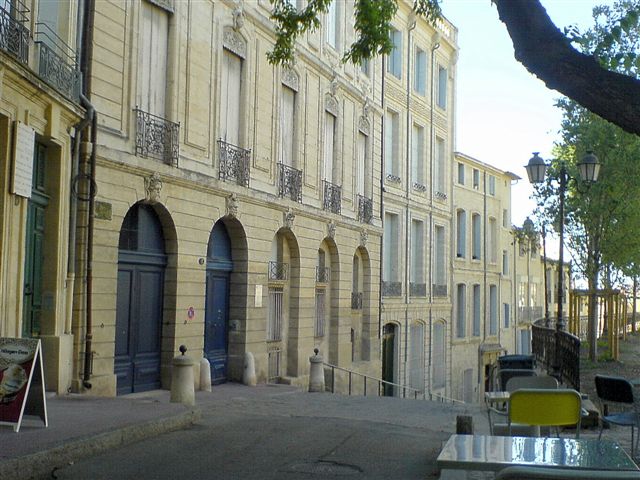
Voyage: Montpellier


Ce weekend j'ai eu la chance de pouvoir visiter Montpellier, dans le sud de la France. Capitale du département de l'Hérault et de la région de Languedoc-Roussillon, Montpellier est une superbe ville méditérranéenne, presque parfaite. Elle a été planifié pour être vraiment vécue par les piétons, dans le centre ville mais aussi dans des parties plus modernes comme Antigone. Près de la mer et pas loin des montagnes, touchée par un climat superbe, elle est un régal pour le visiteur, avec le mélange de petites places, ruelles de pierre calcaire, boulevards, etc. En plus avec le superbe temps qu'il faisait, j'ai presque oublié le nord... il faudrait y aller plus souvent. Cliquez ici pour voir quelques photos.

Cinema/tv: "Six Feet Under" is over


Six Feet Under is over. It is for me now because I just finished watching its fifth and last series. But in fact it was concluded in August 2005, although it was only now released on DVD. It was a critically acclaimed and popular television drama produced by HBO, who have already produced excellent series like “Sex & the city”. It first started on June 3, 2001 and went on for five years!

The show was created by Alan Ball and revolves around a family funeral business (the Fisher) run by two brothers, and the rest of the family and the relationships around the family. It is set in present day Los Angeles, California (2000–2005).

Although it is a conventional family drama, dealing with the usual issues as relationships, sex, infidelity and religion it is quite original and innovative, not only for its focus on a “different” topic – death – but also for the sometimes profound way it presents the characters and human relations and explores this on multiple levels (personal, religious, and philosophical). Each episode always begins with a death (with two exceptions) which will be dealt by the funeral home and which sets the tone.

Over the last months I had developed a certain anxiety towards "Six Feet Under," waiting eagerly for the final series to come out. Despite the fact that the series was not always perfect, that it was sometimes frustrating to see how it sometimes just didn’t advance or the inconsistencies of the characters (one minute George can't go out shopping by himself, some episodes later he's giving a well-prepared speech at Nate’s funeral; one minute Vanessa is manic depressive and driving Rico away, and the moment he finally cheats on her, she's gets magically cured) and other typical soap opera tendencies, it becomes addictive and one becomes “part” of the Fisher’s life and is eager to know what will happen next and will wait eagerly for the next dialogues.

After all, the ending was quite satisfying and original, for such a series, which wasn’t won in advance. The last five minutes show the death of all the central characters, in the future and was particularly moving (the final death occurring in 2087). Yet somehow at the end it is quite frustrating because we end up wondering all that would happen to the family and all the characters.

All in all, an interesting series, superbly interpreted by nearly all the actors, which makes us wait for other original series by HBO. To be recommended.

Read more: click here and/or here.

30 mai 2006

Travel: Barcelona posa't guapa!


Barcelona is definitely one of my favourite cities. A fascinating city, it has got everything: history, style and many architecture styles, design, monuments, museums, shops, a great location and a nice climate, an eclectic mixture of modernity and tradition, of old and new, avant-garde, sea, mountain, good food, good looking people. Here is a small tribute to that special mediterranean port, with some photos I took. Not necessarily the usual monument - Gaudi - grand boulevards of the Eixample pictures, but rather from popular areas or mixed areas like Raval, Bairrio Chino, El Born but also from other parts, even Sitges... details that have kept my attention. To be completed hopefully in future trips... click here

Music: new I AM X album


After the excellent first album "Kiss & swallow", Chris Corner, formerly from the group Sneaker Pimps, has brought out the new release of his group's I AM X, “THE ALTERNATIVE”, last April 21st 2006 (out in Belgium as well but not in France yet). This album is even better than the first one, and is to be heard in-one-go… non-stop… actually it is to be heard as one long song... It's a sad and romantic album, for those melancholic moments, when you feel like being alone or when you feel that the world has left you alone.

The first track "The president" is now available as a free download.

I AM X is now touring Europe with its Alternative tour, until mid August. I have unfortunately missed them in Brussels last May 6, when they played @ the
Botanique, but there will be a new chance maybe when they play at the Dour Festival (not far from Mons) next July 15.

Music: Kitsuné again


La maison Kitsuné (connue pour ces excellentes compils Kitsuné Midnight et Kitsuné X) sort sa nouvelle compilation Kitsuné Maison 2. La compilation, qui veut être la découverte de nouveaux talents, offre une sélection de morceaux de tous horizons très éclectique avec Wolfmother, Bloc Party, Cazals, Azzido da bass, Joakim, Digitalism (excellent!), Simian Mobile Disco, Fox n wolf, Adam Sky, Next level Pop.... Cette compil sera disponible en avant-première chez Colette à Paris (for the lucky ones…) et sera aussi dispo sur eshop de Colette (attention, leurs envois par poste prennent sont temps).

[EN]
Kitsuné brings out (known for its excellent compilations Kitsuné Midnight & Kitsuné X) its new CD Kitsuné Maison 2, reinforcing Kitsuné's status as discoverers of new talents. This album presents an ecclectic collection of tracks by superbly-sentimental groups/singers, such as Wolfmother, Bloc Party, Cazals, Azzido da bass, Joakim, Digitalism (yeah!), Simian Mobile Disco.... The CD will be on pre-sale available @ Colette in Paris (yes, for the lucky few) and can be ordered from the Colette e-shop, as from June 1st.

29 mai 2006

MUSIC: The Barcelona Spring festivals are coming!


The twelfth edition of the Sonar festival will be held on 15th, 16th and 17th of June 2006 in Barcelona. Those will be three days and three nights in touch with the most up-to-date music developments and featuring relevant Spanish and international artists. Sónar will be presenting over 300 activities including DJ sets, concerts, films projected at the SonarCinema and works in every multimedia format: installations, Net art, design, etc. Sónar aims to be an essential meeting point for an alert public, cutting-edge and avant-garde artists and the most influential professionals from the sectors of music and modern arts.

Sonar by day presents Concerts, DJ sets, a professional fair, a multimedia area, audio-visual projections in all formats, a mediatheque, conferences and exhibitions. Nights at Sónar are of a distinctive nature, an enormous cosmopolitan celebration, similar to other European music events but with a Mediterranean flair, giving it a unique atmosphere. Each night DJs, VDJs perform concerts from the broadest spectrum of dance music simultaneously in 4 areas, occupying an area of more than 10,000 meters, divided between covered and open-air spaces.

Sonar will stage some well known and other less-known names from the world of electronic music, such as Jimmy Edgar, Jeff Mills, Ángel Molina, Goldfrapp, Miss Kittin, Modeselektor, Agoria, Wagon Cookin´, Hot Chip, Dave Clarke, Disco D, The Infadels, Isolée, Richie Hawtin vs Ricardo Villalobos, Tiga, Gilles Peterson, Laurent Garnier & Bugge Wesseltoft and Herbert among others.

The prices are not cheap… the General Pass for the 3 Days + 2 Nights of the festival costs 130€ while the Day Ticket is 25 € and a Night Ticket 40 €.

But Barcelona never stops, never sleeps... In the meantime, the
Estrella Damm Primavera Sound festival will take place from June 1 to 3. This year's edition changes location from the Pueblo Español in Montjuic to the previous location of the Forum of the Cultures of 2004, at the end of Diagonal avenue - see website for details.

This year's edition will include musicians, DJs and groups like 2 Many Dj's, Ellen Allien & Apparat, Lou Reed (yes!), M.A.N.D.Y., Erol Alkan, Stuart A. Staples, The Flaming Lips, Yeah Yeah Yeahs, José González, Killing Joke and the spanish cult group La Buena Vida, among others.

Tickets are also not cheap, a three-day tickets 115 € while day tickets for Thursday 1st of June are 40 € and 65 € for Friday 2nd and saturday 3rd. You also have the chance to listen to all the artists and news from the Primavera Sound festival on the alternative radio from Barcelona
ScannerFM, monday to fridays at 17:00.

So what are you waiting for? Check out your local low cost companies (Vueling, Virgin, Ryanair, etc) and book your flights to Barcelona... the place to be... and not only for its music festivals!

Citizenship: Gay Pride banned in Moscow


At a time of the year when Gay Pride marches are being held all around the world, commemorating the Stonewall riots (which took place in New York in June 27, 1969, 37 years ago) and cellebrating the pride and right to be "different", Moscow saw the first-ever attempt to stage a gay-pride march end in violence, injuries and mass arrests, last saturday, May 27.

Despite Mayor Iuri Loujkov's ban, activists took to the streets to protest. More than hundred people were jailed for questioning by the Moscow police force and tens of protestors violently attacked by skinheads and religious extremists saturday, who shouted "Moscow is not Sodome!". The Gay Pride had been banned by the Mayor of Moscow, Iouri Loujkov, considering that such an event was morally "inadmissible". His decision had been backed up by the Tverskoi District Court.

Nikolaï Alekseïev, leader of the organisation "GayRussia", which defends gay rights in Russia, was attacked, with several other activists when they tried to approach the unknown soldier's tomb to deposit flowers, as noted a journalist of AFP. The aim of the gesture was to show a parallel between the prohibition of the Gay Pride, the fight against gay rights and the fight against nazi Germany.

Some members of Parliament, official representatives and journalists from the US, France, the UK, the Netherlands and Germany had come to Moscow to support the local gay community and to protest against the ban of the parade. Volker Beck, a German Bundestag delegate, was hit and had his face in blood, while others were also attacked. Philippe Lasnier, from the cabinet of the mayor of Paris, Bertrand Delanoë, was briefly taken in for questioning by the police. Another French participant declared that "the situation of gays in Russia is even worse than I imagined". Foreign delegations had come to demonstrate peacefully but were astonished by the lack of support from the police to protect the demonstrators of the attacks of skinheads and orthodox extremists.

At a time when Russia takes the chair of the Council of Europe and has won a seat in the Human Rights Council of the UN, these facts are extremely worrying. In fact the Russian authorities do not seem to allow minorities the freedom of expression. In a press conference Nikolaï Alekseïev considered that homophobia is only a part of Russia's broader problem of xenophobia.

Read more also at
Ilga's website.

[seen in Le Monde] [source of the picture: Ilga's website]

Citoyenneté: Xénophobie et homophobie à Moscou


Arts: Expo Almodovar à la Cinémathèque Française à Paris


La Cinémathèque Française à Paris s'est mis à l'heure du plus fameux et atypique des cinéastes espagnols. Le nouveau lieu de la Cinémathèque à Bercy ouvre ses portes à Almodovár, jusqu'au 31 juillet 2006, pour une exposition accompagnée de rencontres, d'une rétrospective de ses films et d'une programmation de ses coups de coeur cinématographiques, présentant un large portrait du cinéaste et de son univers.

Après vingt-cinq ans de carrière, Almodovár incarne toujours le renouveau: avec chaque film on espère qu’il nous surprenne, qu’il nous séduise, qu’il nous émeuve et nous transporte dans son univers unique… on demande à chaque fois qu’il soit toujours plus Almodóvar. Un Grand cinéaste, très espagnol mais très universel, léger et grave, comique et tragique, plein de contrastes et de couleurs. Pas facile d'être à la hauteur des atteintes du public, mais ces films sont toujours intéressants.

L'exposition parvient à nous faire "plonger" dans l'univers "almodovarien" et nous propose un parcours d'entretiens, scènes anthologiques de ces films, objets, de décoration et même des courts jamais vus… des curiosités cinématographiques. Je conseille vivement cette expo, il ne faut pas la manquer… la
¡ Almodóvar Exhibition !

- Le programme complet

24 mai 2006

CITIZENSHIP: Amnesty International brings out 2006 report

Amnesty International has published its 2006 Report [en français]. This Report documents human rights abuses in 150 countries around the world. It highlights the need for governments, the international community, armed groups and others in positions of power or influence to take responsibility. It also reflects the vitality of human rights activists globally, whether in local initiatives, international summits or mass demonstrations. "Outraged by continuing human rights abuses and inspired by hope, Amnesty International members and supporters around the world campaign for justice and freedom for all."

According to AI, during 2005 some of the world’s most powerful governments were successfully challenged, their hypocrisy exposed by the media, their arguments rejected by courts of law, their repressive tactics resisted by human rights activists. After five years of backlash against human rights in the “war on terror”, the tide appears to be turning. Nevertheless, the lives of millions of people worldwide were devastated by the denial of fundamental rights. Human security was threatened by war and attacks by armed groups as well as by hunger, disease and natural disasters. Freedoms were curtailed by repression, discrimination and social exclusion.

The report has of course been received with different enthusiasm by the different countries and organisations. AI denounces that sometimes those countries which refer most to democratic values, of justice and freedom that are sometimes in a position to violate human rights. For the US, however, a spokesman has recalled that it was precisely AI the first to denounce Saddam Hussein's regime. The US considers that the NGO should better focus in participating in the process of the ex-dictator instead of denouncing the use of mercenaries in Iraq or the situation in Guantanamo.

The report focus on several issues and considers that there is reason for hope:


· DEATH PENALTY: there are good reasons for hope. By 2005, 122 countries had abolished the death penalty in law or in practice, in comparison to only 16 abolitionist countries in 1977.

· HYPOCRISY: In 2005, the US Administration acknowledged the use of "renditions". Rendition is the practice of transporting persons forcibly and without due process from one country to another where they risk being interrogated under torture or ill-treatment. AI says that renditions are illegal under international treaties to which all European governments are party.

· DUPLICITY: Governments championed human rights on the one hand, and undermined them on the other (examples needed?).

· TORTURE: 141countries are party to the UN Convention against torture and other ill-treatment. However, 104 countries out of the 150 countries in AI’s 2006 report that have tortured or ill-treated people.

· PARALYSIS OF THE INTERNATIONAL COMMUNITY: The conflict in Darfur has been described as staggering in scale and harrowing in nature. Urgent action is needed by the United Nations and the African Union to protect civilians in Darfur. Since 2003, there has been an estimated number of deaths from starvation, disease and killings of some 285,000 plus 2.2 million refugees and people displaced by the conflict. In the meantime, 13 UN Security Council resolutions have been adopted on Darfur, but ZERO United Nations peacekeepers have been deployed in Darfur.

· FAILED PROMISES: At the Millennium Summit in 2000, the world’s leaders set clear targets to solve some of the most vexing global social problems. But, they failed to turn their promises into performance. For instance, Governments promised to achieve universal primary education by 2015, however still more than 100 million children remain out of school. At the same time there is an estimated number of child soldiers of 300,000.

· TORTURE & TERROR: Thousands of people have been detained without charge or trial, tortured and ill-treated in the name of counter-terrorism, as for instance in Guantanamo.

- VIOLENCE AGAINST WOMEN: From birth to death, in times of peace as well as war, women face discrimination and violence at the hands of the state, the community and the family. 2 million girls are still at risk of female genital mutilation each year. Only 9 countries have specific legislation outlawing female genital mutilation. Also 25% of women experience sexual abuse by an intimate partner in their lifetime. 79 countries have still no legislation against domestic violence.

· ARMS CONTROL: The proliferation of small arms is fuelling conflict, poverty and human rights abuses worldwide. 1000 is the average number of people killed every day by small arms !!! 1 to 10 - for every $1 spent on development assistance $10 is spent on military budgets. Plus: 88% reported conventional arms exports are from the 5 permanent members of the UN Security Council: China, France, Russia, UK and USA !!!

None of this is surprising, since, as the report well says, this is a world of duplicity and hypocrisy. To notice only that the
violation of human rights based on sexual orientation does not seem to be one of the priorities for AI, and there also is a lot to be reported…

22 mai 2006

Arts: the 25 sexiest novels ever written

The magazine PlayBoy has just established the classification of the 25 sexiest novels ever written. In the top ranking appea "Memoirs of a Woman of Pleasure (Fanny Hill)" by John Cleland, the "Lady Chatterley's Lover" by D. H. Lawrence and "Tropic of Cancer" by Henry Miller. "Some of the titles were famous for being dirty books for decades, contraband smuggled in the US from Paris. A few were champions in the courts, books that freed the language. Some tackled taboos. Others showcased attitude -- either curiosity or humor or energy. To us, they are the ultimate love stories". Check out for yourself.

[Fr]
La revue coquine PlayBoy vient d'établir le
classement des "25 romans les plus sexy jamais écrits". Figurent dans le peloton de tête, les sulfureux Fanny Hill de John Cleland, L'Amant de Lady Chatterley de David Herbert Lawrence et Tropique du Cancer d'Henry Miller.

[seen at "le Monde Digital"]

World - Darfour: where is China?

A lead journalist from the international Herald Tribune asked Mr Bush this question. Bush has recently asked the international community to join the American effort in ending the Darfour "genocide" (in Sudan). Knowing that the rich and proud Chinese civilisation has a saying for each circumstance and bearing in mind that China buys 60% of the oil production of Sudan, i.e. 7% of its imports, a proverb comes to mind: "the large tree get the wind." The Chinese "tree", which grows so quickly, has a small "offspring" diplomacy which remains in an unfortunate state of no growth, argues the IHT. Beijing states that it "respects all the cultures and all the regimes". Very convenient, I add. This shouldn't be seen as a sign of "immaturity" but rather of "cynicism" writes the journalist. China will probably not use its veto in the Security Council when the UN will try to put pressure on Khartoum. On the spot, the African Union has huge difficulties in trying to control a conflict which has already made 200,000 deaths and some 2 million refugees, writes the New York Times. China knows this and should take an active role. This should also be the message that Angela Merkel will try to convey during her first official visit to China, requesting Chinese authorities to take a more active role in solving the world's conflicts. Obviously, the UN, the world powers and the World have not learnt with the Rwanda (tragic) experience.
[read in "Le Monde Digital"]