31 mars 2006

Monde: journaliste, proféssion à risque


65
C'est le nombre de journalistes qui ont été tués en 2005 dans le monde, 13 de moins qu'en 2004, selon le rapport de l'IPI, publié hier à Vienne. L'Irak, où 23 reporters ont péri, "demeure l'endroit le plus meurtrier au monde pour la profession". Depuis le début de la guerre 86 journalistes ont été tués en Irak.

lisez encore:
http://www.freemedia.at/Death_Watch/d_watch_main.htm
http://www.rsf.org/rubrique.php3?id_rubrique=19

30 mars 2006

Music: long live the Cocteau Twins

I first listened to Cocteau Twins by the mid eighties, as I discovered 4AD and other bands like This Mortal Coil, Propaganda, Clan of Xymox and others… Cocteau Twins sounded strange, like coming somewhere from outer space. I remember trying to figure out their lyrics only to discover that there were only voice sounds but no words. It was a time of melancholy and depressive music, in general, the time of british new wave. The Cocteau Twins were founded in 1981 by Robin Guthrie, Elizabeth Fraser and Will Heggie (who left in 1983) in an industrial town in Scotland. In 1984 Simon Raymonde joined Robin and Liz until their breakup in 1998, when Liz left London and decided to follow a solo career. By then the band had made its unique contribution to pop music,. Its prolific creativity had already left an indelible mark on music that will, no doubt, last forever, with its legacy of songs like "Pearly-Dewdrops' Drops," "Lorelei," "Aikea-Guinea," "Pink Orange Red," "Orange Appled," "Carolyn's Fingers," "Iceblink luck" and "Heaven or Las Vegas." Even nowadays, a 15 year-old Cocteau Twins song like "Fifty-fifty Clown" sounds as fresh and new as if it were recorded only yesterday. The music of the Cocteau Twins remains unique and has influenced many famous singers and groups. The three elements of the band have continued solo careers and Liz Fraser in particular has been remarked, having worked with Massive Attack for instance.

For its 25th anniversary, an year in which the band nearly reunited, 4AD and Robin Guthrie digitally remastered and re-released the full back-catalog of Cocteau Twins EPs, singles and b-sides, including all non-4AD tracks from 1993 to 1996. The new set, entitled "Lullabies to Violaine", (from the album Lullabies to the album Violaine) was released in November 2005 including 59 tunes. previously in 2000 a two-CD collection of radio show performances (BBC Sessions) had been released on Bella Union. That was followed in late 2001 by an eighteen-track digitally remastered retrospective from 4AD entitled "Stars and Topsoil", which chronicled highlights from their career with their long-time record label from 1982 to 1990.


For more details and the latest news, read more in the band’s website: www.cocteautwins.org

politique: L'UE gagne à Kiev et perd à Minsk, par Thomas Ferenczi


Politique: Fin du Grand Israël


Fin du Grand Israël
LE MONDE 30.03.06

© Le Monde.fr

Cidadania + política: Blog regionalização

Ainda sobre o tema da regionalização em Portugal, aconselho a consulta urgente do blog "Regionalização- um imperativo nacional" (http://regioes.blogspot.com/), com artigos interessantes e debate aberto sobre este tema. E obrigado à Cristina por me ter aconselhado este blog.

29 mars 2006

Economy: Global Information Technology Report 2005-2006

The United States tops the rankings of The Global Information Technology Report 2005-2006’s “Networked Readiness Index” for the third time in five years, maintaining its position as a leader in the area of innovation and confirming its position as an information and communication technology powerhouse. It is followed by Singapore and the Nordic countries, while Portugal climbed from rank 30 to 27, out of 115 countries. For more info in Portuguese check newspaper Publico of March 29, 2006 (paying). Portugal does better than other southern European countries like Spain, Italy and Greece (ranked 31, 42 and 43 respectively).

With record coverage of 115 economies worldwide and published for the fifth consecutive year, the report has become a respected assessment of the impact of information and communication technology (ICT) on the development process and the competitiveness of nations. It is produced by the World Economic Forum in cooperation with France's INSEAD and is sponsored this year by Cisco Systems. All ranking exercises of this type have an element of arbitrariness, depending on how the indexes are compiled. However, the leaders tend to be roughly the same whatever the criteria in the recent years, with the same countries featuring regularly in the top 10. It must however be noted that some results are surprising (as is the case with Argentina – see bellow) and I have difficulty in accepting the report’s total credibility and independence.

The report proposes the Networked Readiness Index (NRI), which measures the propensity for countries to leverage the opportunities offered by ICT for (economic) development and increased competitiveness. The index rates each economy for its broad ICT environment, such as regulation and infrastructure, the readiness of community’s stakeholders (individuals, businesses and governments) to use ICT, such as education quality and spending on research and development, and use of ICT in practice. Augusto Lopez-Claros, director of WEF’s global competitiveness network, said: “The US has been for many years an ICT powerhouse, and its sustained ability to harness these technologies so effectively…provides a standard of measurement for other countries wishing to rapidly improve the living standards of their citizens.”

After the US, the Nordic countries and other usual European countries, some Asian and Pacific countries do extremely well with Taiwan, Hong Kong, Korea, Australia and Japan very well placed (ranks 7, 11, 14, 15 and 16, respectively). India maintains its 40th place while China strangely drops 9 positions to 50th place, widening the performance gap with respect to India. The highest ranking Latin American countries are Chile (29), Brazil (52) and Mexico (55), while Argentina is only 71! . Personnally, having had the chance to visit Argentina and Chile recently, it doesn't seem to me that this difference reflects reality in those countries and makes little sense. Argentina seemed to me very developed in terms of ICTs uptake, and not worse than Chile in any case, as regards use of internet, websites for everything; I had access to mobile phone services everywhere throughout the country and even in remote areas, which was not the case in Chile. The difference between Chile (29) and Argentina (71, behind countries like Mexico, Egypt, Pakistan or Indonesia, to name but a few) doesn't make much sense, in my view. And that doesn't contribute, in my undertsanding, to give credibility to this report and this index. It’s just a reference...

Some extracts:"The global economy is being changed in profound ways by the onward march of science and technology. Technological change has, of course, always been a central engine of economic growth, but what is significant about the past decade is the acceleration in the pace of change and, as more and more countries have made efforts to improve their macroeconomic and policy environments, technology and technological innovation appear to have entered a “golden age”, a time when they are emerging as the key drivers of growth and development. Indeed, the competitiveness of nations has come more and more to depend on the presence of vibrant ICT sectors, on the related technological readiness of the three main national stakeholders: government, businesses, and individuals, and on their ability to adopt emerging new technologies. This is especially true for countries, whose level of development places them near the technological frontier, and whose prospects for continued competitiveness lie fundamentally in their innovation potential and technological skills.
There are, to be sure, still many basic battles to be won in the developing world, addressing fundamental issues of development, from reducing poverty levels and the incidence of disease to enhancing opportunity and the quality of life for large segments of the world’s population.But, as economists are prone to point out, what matters most is what happens “at the margin,” and at the margin technologies today—particularly information and communications technologies (ICT)—are increasingly playing the central catalytic role in pushing the development process forward.
The Global Information technology Report 2005–2006 appears at a time of growing concern about a range of emerging global challenges.The world’s population is projected to exceed 8 billion by 2025, 2 billion more than at the outset of the 21st century.This will have fairly direct implications in a number of key areas, from energy consumption, to job creation, to management of the global environment. How countries are able to adapt to the fast pace of change and cope with the challenges that are implicit in the emergence of an increasingly complex global economy will depend heavily on how adept they will be at formulating intelligent policies, and modernizing the institutional framework which forms the basis of modern societies. It is becoming evident that the more successful countries are those in which governments, businesses, and civil society have evolved mechanisms that facilitate consultation and cooperation, and which lead to giving a high priority to boosting education and training. (…) Future prosperity seems increasingly to be as much a function of investment in human capital and the technologies that will enhance productivity, as it is of investment in physical capital and infrastructure.(…)

playlist march 06

ces disques tournent chez moi... / a música que ouço no momento...

singles

CAJUAN/ Dance not Dance (Digitalism remix)
DIGITALISM / Idealistic

THE INFADELS /can’t get enough (Jags Kooner remix)
LIQUID ARCHITECTURE /rose c`est la vie
TELEX /on the road again (Telex mix)
HIEM /Zombie party
LIFELIKE & KRIS MENACE /Discopolis
MIDNIGHT MIKE & MUNK / Disco Clown (Digitalism Remix)
JUSTICE VS. SIMIAN / Never Be Alone (Dj Hell's Bavarian Gigolo Mix)
THE YOUNGSTERS FEATURING ALIX & CORINNE /There Came Une Musique (Original Version)
DIGITALISM / Idealistic
HOT CHIP / Over and over (Justus Köhncke mix)
EXTRAWELT / Soopertrack
KANYE WEST feat JAY-Z / Diamonds are forever
ALEX SMOKE / Lost in sound
PELLE BUYS / Enemy mine

Albums


THE INFADELS /murder that sound
in bed with NOVA /deuxième nuit
JAPAN / The very best of…
HOLDEN / Chevrotine
DIVING WITH ANDY / Diving with Andy
Mad about Blue Sidetracks Vol. 6 - various
SHE WANTS REVENGE / she wants revenge
I LOVE YOU BUT I’VE CHOSEN DARKNESS / Fear is on our side

NATHAN FAKE / drowning in a sea of love

27 mars 2006

Cidadania: quem falou que as regiões-plano são consensuais?


No Diário de Notícias de 25-03-06, António José Teixeira escreveu: "Portugal vai regionalizar-se tecnicamente para mais tarde se regionalizar politicamente. Dito de outro modo, como a política só atrapalha, nada melhor do que regionalizar primeiro e perguntar depois."

O governo pretende estes dias aprovar o programa PRACE (Programa de Reestruturação da Administração Central do Estado), que estabelece orientações para a reorganização territorial dos ministérios com base nas cinco regiões-plano actuais: Norte, Centro, Lisboa e Vale do Tejo, Alentejo e Algarve. Parece que estas medidas já faziam parte do Programa de Governo, como referiu José Sócrates. Segundo ele, estas regiões, equivalentes às NUT 2 (nomenclatura de designação de unidades territoriais da União Europeia que corresponde, neste caso, a região, NUTS 1 seria o país inteiro), são "uma realidade estatística, orgânica e de planeamento que se impôs nas últimas décadas e devem ser aproveitadas como ideia de coerência". O governo fala agora em "desconcentração" dos serviços do Estado, e não em regionalização (ainda que técnica), mas o que parece estar em causa é mesmo uma espécie de regionalizão técnica. Segundo o primeiro-ministro, "o PS evoluiu" nesta matéria.

Mas, terá mesmo o PS aprendido com os erros do passado? Parece que não. Quando, há uns 7 ou 8 anos o PS organizou o referendo sobre a regionalização, prestou um péssimo serviço ao país. O PS não estava obviamente interessado na descentralização do poder e na regionalização, porque de contrário teria feito uma preparação correcta do referendo. Primeiro ter-se-ia debatido com os outros partidos e em particular com o PSD, teria podido fazer um “pacto de regime” para um tema tão importante para o país, antes de propor um mapa de regionalização aos portugueses. O mapa regional português teria assim sido objecto de debate público verdadeiramente democrático, as competências e funções das regiões teriam sido devidamente explicadas e debatidas com os cidadãos. E o país não teria perdido dez ou mais anos. A realidade é que em Portugal não existe nenhum nível político-administrativo entre os (pequenos) municípios e o Governo nacional. E esse nível é necessário para a eficácia da gestão político-administrativa do país. Não deverão essas regiões ser comparáveis aos Açores ou à Madeira, que são regiões Autónomas, nem sequer às Autonomias espanholas ou aos Länder federais alemães. Mas deverão ter certas competências em relação a alguns sectores que permitirão, no mínimo, coordenar acções e políticas a uma escala territorial adequada (por exemplo a nível de desenvolvimento rural, regional, transportes, energia, saúde). E teriam um executivo eleito responsável e imputável.

Depois do anterior referendo o governo PSD propôs a criação da charada chamada “regiões metropolitanas” e “comunidades urbanas”, uma fantochada que felizmente parece ter dado em nada. Mas parece que afinal alguns líderes se deram conta da necessidade da regionalização mesmo como factor de democracia, contribuindo a aumentar a participação das regiões e dos cidadãos na vida político-administrativa do país e consequentemente podendo contribuir para reequilibrar o desenvolvimento do país, tão polarizado em Lisboa.

As intenções do PS são de fazer novo referendo no início da próxima legislatura (supondo que continua no governo) e começa já a preparar a desconcentração segundo o modelo que preconiza para a regionalização do país. Sócrates considera que o modelo das cinco regiões "é hoje consensual, não só no PS como noutros partidos e na comunidade técnica e científica"! Mas quem falou que este modelo é consensual? Gostaria de saber a que líderes partidários e a que comunidade científica se refere! Eu não vi nada! Estarei a sonhar?


Gostaria de saber quem decidiu, e de que forma "democrática", criar estas regiões-plano, mas que já não correspondem às 5 inicialmente criadas. No fim dos anos 90, antes da aprovação do actual Quadro Comunitário de Apoio do FEDER (Fundo Europeu de Desenvolvimento regional) da União Europeia para o período 2000-2007, a anterior região de Lisboa e Vale do Tejo foi dividida (ver foto) por razões estatísticas e financeiras. Assim, a sub-região (NUTS 3) do Pinhal Interior sul (basicamente o sul do Ribatejo) passou a integrar a região do Alentejo, a região do Pinhal litoral (basicamente a Estremadura) passou a integrar a região Centro assim como o norte do Ribatejo. E apenas a zona metropolitana de Lisboa ficou na chamada região de Lisboa e Vale do Tejo. Esta divisão foi feita de forma puramente administrativa, para que as regiões do Ribatejo e Estremadura não perdessem os fundos europeus do FEDER, por estarem integradas numa região rica (a de Lisboa). E foi assim que, estatísticamente, a região do Alentejo deixou de ser a região mais pobre do continente. Mas esta divisão foi feita sem perguntar nada aos portugueses nem a ninguém, aliás apenas por razões burocráticas e administrativas.

E agora o PS e o Primeiro Ministro consideram que esta divisão é consensual? Mas como? Para quem? Como é possível levar este processo a sério?

A minha conclusão é que das duas uma: ou o governo está a meter os pés pelas mãos e vai de encontro à parede, pois arrisca-se a levar um rotundo “NÃO” quando fizer um referendo possivelmente em 2009, ou então é deliberado e apenas se pretende fazer uma desconcentração dos serviços do Estado mas não uma regionalização.

A questão é que o país já vai perder 10 anos ou mais com o atraso da regionalização e arriscamo-nos a perder mais. Entretanto as regiões portuguesas perdem competitividade para muitas regiões europeias, bem mais activas a nível europeu pois com competências e legitimidade democrática. Muitas regiões europeias estão bem representadas em Bruxelas, seguindo de perto o processo de construção e legislativo europeu, e são bem activas. Portugal não tem uma única representação regional junto das instituições europeias, nem sequer da Madeira ou dos Açores. E as regiões espanholas continuam também a não ter interlocutor do lado português o que dificulta o processo de cooperação, tão necessário a vários níveis, perdendo mais uma vez o país competitividade.


Mas quanto mais tempo será ainda necessário para que se entenda tudo isto e que o processo democrático da regionalização seja conduzido satisfatoriamente?

Will music-player mobile phones kill off the iPod?


Not so long ago, to be really mobile, one would have to buy a mobile phone, a digital camera, an mp3 player and a pda (personal digital assistant), all separately of course. Some brands started integrating these four functions like Nokia (with their old big pda & mobile phones) and more recently most mobile producers have integrated digital cameras in their handsets, although of pitiful quality in the beginning. Now some phones offer cameras with 1.5 or even 2 megapixels (which allows to take quite reasonable quality pics, even though good digital cameras do 5 or 7 Mpixels).

In the meantime the digital music market exploded with all the mp3 players of which the iPod got to be the most famous and dominating the market. More recently some mobile phone companies started exploring that promising market as well. After timid attempts at music-player phones by Motorola (with the 100-tune holding ROKR, with iTunes) and Sony-Ericsson (with its Walkman with flash memory cards of 512 MB extendable to 1 GB) two more have come into this market – Nokia and Samsung, which are introducing hard-disk phones. These go one step further as the previous generations. The Samsung SGH-i310 and the Nokia N91 now offer capacity for 2,000 and 3,000 tunes respectively (4MB/song). Plus a 2 Megapixel camera on top of that. But Sony-Ericsson seems to be changing its strategy, having improved the walkman offer with its most recent handsets like the W950i Walkman (with a Flash memory card of 4GB) or the Walkman W810, with tactile screens to facilitate handling. But these don’t offer a camera anymore. The P990i remains an alternative for a mix of pda and mobile handset, with tactile screen.

The news is that Nokia, after dragging its feet for several years, is finally making a jump to the forefront of mobile technology again. Part of the N series of multimedia handsets, the Nokia N91 smartphone is destined to give Sony Ericsson's walkman series a hard time. Integrating a 4 GB hard drive, the Nokia N91 is a surprisingly small smartphone given its features. And it should support most music formats such as MP3, AAC, WMA and M4A, using an USB 2.0 cable to drag and drop files when connected to a compatible computer. But watch out for Samsung too.

So, with such an offer, what would you do with both a phone and a Nano crowding your pockets ? Even though 1,000 or 3,000 tunes is still nowhere near the top iPod’s 15,000 (60GB), Apple is not taking the threat lightly. And, let’s agree, it would take over 60 hours to listen to 1,000 tunes alone, so for most journeys, the capacity now proposed is perfect. So what will Apple come up with? Even though there isn’t much information, Apple has apparently copyrighted the expression ‘my mobile’ and is certainly looking to design their own handsets.
So maybe we will not have high quality compact integrated handsets that soon (with pda, camera and mp3 player) but, after Apple has revolutionised the mp3 player market, watch out for the mobile phone market!


Competition is fierce out there, but for the meantime my Sony-Ericsson walkman should do. It’s hard to keep up with the offer and technological update…

(the first picture does not display a real offer from Apple, it's only a graphic taken from Mixmag, created by Munnoo)

25 mars 2006

Politics: The Israel lobby in the USA

John Mearsheimer (Professor of the Department of Political Science of the University of Chicago, and the author of The Tragedy of Great Power Politics) and Stephen Walt (Professor of International Affairs at Harvard who recently wrote Taming American Power: The Global Response to US Primacy) have recently published a research paper at the Harvard University press) – The Israel Lobby. The paper wouldn't be published by any american newspaper.

This paper is causing high controversy and reactions in the United States and also in Israel. In the paper, the authors contend that the intimate relationship with Israel has been driving U.S. Middle East policy. The authors argue that although often justified as reflecting shared strategic interests or compelling moral imperatives, the U.S. commitment to Israel is due primarily to the activities of the “Israel Lobby." For the two authors, it's not because of terrorism that the USA are allies of Israel but the other way around: the USA have a problem with terrorism partly because they are Israel's allies. Also the USA wouldn't care so much for the threat of Irak, Syria or Iran if it weren't for Israel's security. The paper goes on to describe the various activities that pro-Israel groups have undertaken in order to shift U.S. foreign policy in a pro-Israel direction. It also accuses Israel of undertaking spying activities in the USA to serve Israel's interests, pretending that Israel does not behave as a faithful ally. An example is the case of Larry Franklin, who has provided top secret information on Iran from the Pentagone to Israel, and who was condemned in January to 13 years in prison. Another is recent sale of Israeli arms to China, which has also not pleased the USA.

In Israel this paper is seen as a cause for alarm. Israel's newspapers, like Yediot Aharonot and Haaretz agree that the USA will, in a post Bush time, most likely be forced to revise their Middle-east policy.

"For the past several decades, and especially since the Six-Day War in 1967, the centrepiece of US Middle Eastern policy has been its relationship with Israel. The combination of unwavering support for Israel and the related effort to spread ‘democracy’ throughout the region has inflamed Arab and Islamic opinion and jeopardised not only US security but that of much of the rest of the world. This situation has no equal in American political history. Why has the US been willing to set aside its own security and that of many of its allies in order to advance the interests of another state? One might assume that the bond between the two countries was based on shared strategic interests or compelling moral imperatives, but neither explanation can account for the remarkable level of material and diplomatic support that the US provides." [ read more . . . ]

Economia: boas notícias do FT

O diário financeiro Financial Times (FT) publicou na terça 21 de Março um suplemento especial sobre a economia portuguesa. O FT dedica seis páginas ao "tempo para decisões difíceis" que o Governo terá de tomar, destacando a "estabilidade política" do país como factor positivo, descrevendo o primeiro-ministro José Sócrates como "um socialista modernizador e favorável aos mercados", e notando que este partilha "uma disposição pragmática" com o Presidente Cavaco Silva. O suplemento também fala no período de estabilidade política de três anos que será positivo para a economia, do programa "empresa na hora" do Governo como um exemplo de "redução da burocracia", nas privatizações (esperando-se 2,4 biliões de € da venda de 8 empresas), que trazem um estimulo à bolsa; e escreve que "nos últimos meses não passa uma semana sem a assinatura de um novo contrato de investimento ou memorando de entendimento a valer centenas, às vezes milhares, de milhões de euros". O FT fala ainda da necessária reestruturação da indústria do calçado mas também do turismo, dos vinhos e do golfe como algumas das oportunidades para a economia portuguesa. O suplemento está disponível (não na totalidade) em www.ft.com/portugal2006.

Citações:
> Painful measures are being implemented to put the country back on track. In the economy, conflict between the need for austerity and the desire for growth will not be easily resolved. Hopes are high for a period of stability in government after four changes of administration in four years. + Portugal, according to a number of international reports, should be fighting an uphill battle to attract inward investment. + Increases in wage costs, these analysts say, have not been matched by corresponding improvements in productivity, making it hard to compete with low-cost countries in eastern Europe, Asia and Latin America. + Over the past five years 13 foreign shoe companies, including big international groups such as Britain's C&J Clark, have closed plants in Portugal, leaving more than 5,000 people out of work. Their departure for lower-cost locations in Asia and eastern Europe dealt a heavy blow to small northern towns such as Felgueiras and Santa Maria de Feira, the heart of the Portuguese footwear industry, which accounts for almost 5 per cent of the country's total exports and 6.5 per cent of manufacturing jobs. <

24 mars 2006

L'Europe tiraillée entre la "flexisécurité" des pays nordiques et le néolibéralisme


Cidadania: os privilégios da Igreja católica continuam

Hospitais (e não só) só para católicos: em alguns estabelecimentos do Estado como hospitais, prisões, quartéis, e mesmo escolas, a igualdade religiosa ainda não chegou. A igreja católica mantém os privilégios herdados do Estado Novo, que contrariam a Constituição e a lei da liberdade religiosa. É tempo de acabar com as capelanias oficiais da Igreja Católica, que ofendem o princípio da separação entre o Estado e as igrejas, para que os ministros de todas as confissões possam também ter acesso a essas instituições e para que possam prestar assistência religiosa aos respectivos crentes que o desejem. Mas nas escolas públicas e outros locais públicos devem também desaparecer os símbolos religiosos. A igualdade e a liberdade (religiosa neste caso) ou é para todos ou não existe, e não podem continuar sequestradas pelos privilégios da Igreja católica.

visto em causa-nossa blog

museu da língua portuguesa de São Paulo


No dia 20 de Março foi inaugurado pelo governador de São Paulo, Geraldo Alckmin, o Museu da Língua Portuguesa de São Paulo, Brasil, no coração mesmo da cidade, na Estação de trens (comboios) da Luz. Parece ser a primeira instituição totalmente dedicada ao idioma de um país.

Aparentemente este não é um museu aborrecido daqueles que provocam sonolência e enfado, não evocando bustos de Camões e outros, óleos sobre o descobrimento com índios nus e edições antigas de Pero Vaz de Caminha ou Gonçalves Dias. Nada disso. Este museu foi concebido como uma viagem, ou várias, como um ponto de encontro com a língua, a literatura e a história, proporcionando uma viagem sensorial e subje(c)tiva pela língua portuguesa, guiada por palavras, autores e pelo povo do Brasil. Um museu interactivo com diversas mídias, com filmes, audição de leituras e sotaques diferentes.


Instalado no prédio acima da plataforma de trens/comboios da Estação da Luz, o museu conta com um vasto conteúdo sobre a história da Língua Portuguesa, os idiomas que ajudaram a formá-la, as formas que a linguagem assume no cotidiano/quotidiano e a criação da língua na literatura brasileira, entre outros temas.

E para quando um museu da lusofonia em Lisboa, sobre a(s) viagem(ns) da lusofonia pelo mundo?

23 mars 2006

World Poetry Day

We celebrate today the World Poetry Day 2006, which was launched by UNESCO in its 30th Conference of 2000. This year Unesco celebrates the centenary of the birth of the great philosopher-poet, Leopold Sédar Senghor, who wrote: “It is enough to name something for the meaning beneath the sign to emerge.”. In Unesco’s website, Mr Koïchiro Matsuura, the Director-General, writes that “poetry is the great way of naming the world, its permanent features and its transformations, in a manner that delights the human spirit. Let World Poetry Day remind us of this magical capacity of poetry in all its forms.”.

At the same occasion, Portugal’s newspaper Publico launches the initiative “a poem a week”, for those of you who can understand Portuguese. They start today, as by chance with a poem by Portugal’s most universal poet, Fernando Pessoa. Critic
Harold Bloom referred to him in the book The Western Canon as the most representative poet of the 20th century, along with Pablo Neruda. I leave you here an excerpt of one of his most famous poems, Autopsychography:

"The poet is a faker
Who's so good at his act
He even fakes the pain
Of pain he feels in fact"

Dia Mundial da Poesia

Comemora-se hoje o Dia Mundial da Poesia, que foi instituído na 30ª Conferência Geral da UNESCO, em 2000.

O jornal PÚBLICO lança hoje uma rubrica dedicada à poesia, “Um Poema por Semana na Internet” com a publicação semanal de um poema. O primeiro, como não poderia deixar de ser, é de Fernando Pessoa. O crítico literário Harold Bloom considerou-o mesmo, no seu livro The Western Canon (O Cânone Ocidental), o mais representativo poeta do século XX, ao lado de Pablo Neruda.

"Liberdade
Ai que prazer
Não cumprir um dever,
Ter um livro para ler
E não o fazer!
Ler é maçada,
Estudar é nada.
O Sol doira
Sem literatura.
O rio corre bem ou mal,
sem edição original.
E a brisa, essa,
De tão naturalmente matinal,
Como tem tempo não tem pressa...
Livros são papéis pintados com tinta.
Estudar é uma coisa em que está indistinta
A distinção entre nada e coisa nenhuma.
Quanto é melhor, quando há bruma,
Esperar por D. Sebastião,
Quer venha ou não!
Grande é a poesia, a bondade e as danças...
Mas o melhor do mundo são as crianças,
Flores, música, o luar, e o sol, que peca
Só quando, em vez de criar, seca.
O mais do que isto
É Jesus Cristo,
Que não sabia nada de finanças
Nem consta que tivesse biblioteca..."

Fernando Pessoa (1888 - 1935) in "Poesias", Lisboa, Ática, 1952 (Colecção Poesia)

Aqui fica ainda um excerto do poema TABACARIA, assinado pelo seu heterônimo Álvaro de Campos:

Não sou nada.
Nunca serei nada.
Não posso querer ser nada.
À parte isso,
tenho em mim todos os sonhos do mundo.”

e alguns links interessantes:
http://www.insite.com.br/art/pessoa/
http://fredb.sites.uol.com.br/pessoa.html

21 mars 2006

Copernicus come back!


Jérôme Bosch (Hieronymus Bosch) a été interdit dans des lycées polonais pour pornographie. Selon l'agence AFP, des inspecteurs de l'éducation dans plusieurs régions polonaises ont interdit la diffusion dans les lycées d'un disque illustré par une reproduction de L'Enfer (volet de droite du triptyque du Jardin des Délices) du peintre Jérôme Bosch au prétexte qu'elle était pornographique. "Sur le tableau de Bosch, il y a des scènes pornographiques qui
peuvent blesser des gens. On ne peut pas donner cela aux jeunes
", a déclaré une inspectrice de l'éducation, citée par le journal Gazeta Wyborcza (centre-gauche). Des inspecteurs d'au moins quatre autres régions ont aussi suspendu la diffusion. il semblerait que le ministère de l'éducation avait prévu de distribuer dans toute la Pologne aux meilleurs élèves du bac un disque du groupe de rock polonais 'Normalsi', dans lequel chaque morceau fait référence à l'un des dix commandements de la Bible. Sur sa pochette figure un fragment du célèbre tableau de Bosch (1450-1516), L'Enfer, avec des personnages nus torturés par des instruments de musique. Il semble que la Pologne recule dans le temps. Auront ils l'intention de dire que la Terre est plate et que le soleil tourne autour de la Terre prochainement?

Do you want to read my blog?


Well, apparently not many people seem to be reading my blog... at least nobody makes any comments. So either people are not reading or they don't care enough to make any comment. Maybe the articles are so clear and good that there's nothing to comment on... However the spirit of a blog is to be able to launch a discussion and to be interactive. I didn't intend it to work only one way and I certainly would like to get some feed back.

Parece que ninguém está lendo o meu blog... pelo menos quase ninguém deixa comentários. Ou seja que não lêem ou estão-se marimbando para perder tempo a escrever um comentário. Quem sabe os artigos são tão claros e perfeitos que não há nada a dizer... No entanto, o espírito de um blog, como eu o vejo, é o de poder lançar uma discussão e permitir trocar ideias entre os que o lêm, ser interactivo, de alguma forma. Não foi minha intenção inicial que fosse um canal unívoco e certamente apreciaria algum feed back.

Il semblerait que personne lit mon blog... au moins presque personne ne fait des commentaires. Soit on ne lit pas soit on s'en fiche carrément et on ne perd pas son temps à écrire un petit commentaire. Peut être mes articles sont ils trop clairs, parfaits, et donc il n'y a rien à dire... Cependant, un blog doit servir, selon moi, comme initiateur de discussions, permettre d'échanger des idées. Ce n'était pas mon intention de faire quelque chose que fonctionne seulement dans un sens, j'apprécie certainement un peu de feed back.

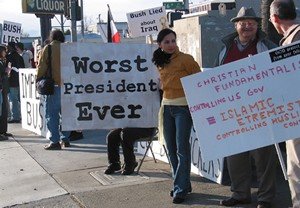
Can the USA continue to afford George W. Bush?

(picture by Gary Zimmerman)

Until recently, talk of ousting President George W. Bush has been very limited, coming mostly from radicals from the political left, groups supportive of anti-war causes (although some calls have come from members of the political right). For too long, impeachment has been deemed implausible. The arguments were that it would not happen with a Republican Congress, not with the president finishing his second term and certainly not while the country was at war.
But today impeachment isn't just a “looming carnival of the absurd”, a mirage in an uncertain horizon – it is a real possibility for 2007. The movement is growing louder by the day, creating a resonant echo that is rapidly taking root in public discourse. The issue was recently brought back to the spotlights by the March’s issue of Harper’s Magazine.
Impeach Him,” reads the cover of the magazine, with an essay by Lewis H. Lapham to the title “The Case for impeachment: why we can no longer afford George W. Bush”. According to Harper’s magazine, on December 18 of last year, Congressman John Conyers Jr. (D., Mich.) introduced into the House of Representatives a resolution inviting it to form “a select committee to investigate the Administration's intent to go to war before congressional authorization, manipulation of pre-war intelligence, encouraging and countenancing torture, retaliating against critics, and to make recommendations regarding grounds for possible impeachment”. Despite the case of the National Security Agency's illegal surveillance of the American citizenry, which was making news by then, the request faced nearly complete silence, attracting little or no attention in the press and television, only some applause from the left-wing blogs and heavy sarcasm on the websites flying the flags of the militant right. When raised the question as to what he had in mind, and who did he intend to address, the congressman answered: “To take away the excuse that we didn't know. So that two or four or ten years from now, if somebody should ask - Where were you, Conyers, and where was the United States Congress, when the Bush Administration declared the Constitution inoperative and revoked the license of parliamentary government - none of the company now present can plead ignorance or temporary insanity, can say that - somehow it escaped our notice - that the President was setting himself up as a supreme leader exempt from the rule of law”.

Also in a public forum in New York City recently, journalists, lawyers, and political figures came together to discuss the case against George W. Bush. In fact, the case for the impeachment of President Bush is arguably the strongest in American history, apparently even comparatively more powerful than the impeachment proceedings of Andrew Johnson, Nixon and Clinton. The Center for Constitutional Rights (CCR) makes this amply clear in its recent book, a concise indictment of President Bush that lays out four clear legal arguments that point to impeachment as a necessary remedy for the gross violation of American Constitution. The Articles of Impeachment Against George W. Bush covers illegal wiretapping, torture, rendition, detention and the Iraq war. Even the Washington Post (claiming that "for some liberal pundits, it's payback time while for some conservative commentators, it's time for uncomfortable explanations") and the N.Y. Sun have brought out articles on the issue. However, some argue that this is not the right moment to go for impeachment, prefering to wait for a possible take over of the Congress by the Democrats, which would facilitate this at a later stage.

But it’s not only Bush that is being criticised, it’s all his team, whose misjudgments and mistakes have led to the deaths of thousands and a mess that continues three long years after Dick Cheney, Paul Wolfowitz, Donald Rumsfeld and others indicated that the war would be long done by now.

Read more on this issue at:
http://www.alternet.org/story/32977/
http://www.blogforamerica.com/archives/007626.html
http://www.conyersblog.us/archives/00000394.htm
http://impeachbushcoalition.blogspot.com/
http://en.wikipedia.org/wiki/Movement_to_impeach_George_W._Bush
http://www.bushlies.com/

20 mars 2006

As desagradáveis surpresas do Iraque...

No Publico de hoje 20 de Março, José Manuel Fernandes, director do jornal, escreve um artigo intitulado “Deve e haver da invasão do Iraque” e, consegue, contra todas as evidências chegar à conclusão que “a decisão [de invasão do Iraque] foi acertada, que o mundo e o Iraque estão melhor sem Saddam Hussein e que se estão a tirar lições do erros cometidos. O mundo continua perigoso, mas ter cedido seria pior”.

Certamente que o mundo, e o Iraque em particular, estão melhor sem Saddam Hussein. Mas há que perguntar, primeiro que tudo, “cedido” a quê? Em que é que Saddam e o seu regime, perfeitamente aniquilados militar e politicamente representavam uma ameaça para o mundo. Depois há que referir que as tais “lições que se estão a tirar” têm um preço humano demasiado elevado. Mas claro, são apenas iraquianos… outro tipo de reflexão não seria de esperar de JMF… conhecido pelas suas posições neo-conservadoras.
Pelo menos tem o mérito de reconhecer que “a invasão do Iraque (…) trouxe-me algumas surpresas desagradáveis”. Apenas é lamentável que não tenha tido na altura a visão geo-política para antever essas surpresas… é que quase tudo o que se passou era bastante previsível. Tem ainda a lata de escrever que “qualquer decisão política é tomada face aos dados conhecidos à época e, segundo, que existia então um grande consenso sobre as armas iraquianas.” (!!!). Quando se sabe perfeitamente (hoje, como se suspeitava já na altura) que a decisão de invadir o Iraque foi tomada com base em “evidências” e informações deliberadamente “fabricadas” e “inventadas” para servir o objectivo traçado pela administração Bush e já perfeitamente estabelecido de invadir o Iraque. Porque Bush julgava necessário na altura fazer alguma coisa para vingar o 11/9 e resgatar o orgulho, tornando-se num herói, o que lhe valeu, digamos, a reeleição em 2004... O que é evidente é que o Iraque não constituía na época nenhuma ameaça para a segurança regional e muito menos mundial. É óbvio que “o Iraque atraiu jihadistas de todo o Mundo” e contribuiu para reforçar a força e campo de actuação da Al Qaeda e congéneres, mas tudo isso era já por demais previsível. Tudo isso é bastante óbvio e consensual hoje, até mesmo nos Estados Unidos, onde 70% da população está hoje contra a guerra do Iraque e crê que foi um mau negócio para os Americanos (com algumas excepções, claro, como os fabricantes de armamento militar ou certas empresas que se instalaram no Iraque e enriqueceram, mas essa é outra história…). Mas O JMF e outros continuam a achar que não, que o mundo é hoje um lugar mais seguro, porque Saddam está na prisão. Mesmo se a História ainda não escreveu as últimas páginas sobre o Iraque, equivocam-se redondamente, pois o mundo não é hoje um lugar mais seguro (como o provam vários atentados cometidos um pouco por todo o mundo) e o Iraque não está melhor do que há três anos atrás.