Affichage des articles dont le libellé est Development. Afficher tous les articles

31 mai 2007

Development: The Global Peace Index and Sustainability


In a new global ranking of the world's most peaceful countries, published yesterday, Portugal ranked 9th. European countries are majority in the group of the ten most peaceful and safe countries. The list is led by the 'usual suspects' in the statistics, first comes Norway, together with the Scandinavian countries with Ireland, New Zealand, Japan and Canada. Belgium comes at 11, Spain at 21, Italy at 33 and France at 34. The U.S. ranks at 96, just beating out Iran which came in at 97. Iraq understandably appears in the last position (121), while Sudan, Israel, Russia, Nigeria, Colombia, Pakistan, Lebanon, Ivory Coast and Angola complete the list of the ten last. Some countries were noticeably absent from the list, namely Afghanistan and North Korea. That was due to the inability to get data.

The
Global Peace Index, was elaborated by Australian philanthropist Steve Killelea for the Economist Intelligence Unit, part of British magazine “The Economist”. A team of international peace experts also provided valuable input, including HH Dalai Lama, President James Carter, Sir Richard Branson and Archbishop Desmond Tutu.

"The objective of the Global Peace Index was to go beyond a crude measure of wars by systemically exploring the texture of peace," said Global Peace Index President Clyde McConaghy. He considered that the effort proves "peace can and has and will continue to be measured."
The index has been tested against a range of potential 'drivers' or determinants of peace - including levels of democracy and transparency, education and material wellbeing. The index table was calculated on the basis of 24 factors, which were weighted by the importance the analysts attached to them, included the levels of violence and of organized crime, the number of internal and external conflicts fought between 2000 to 2005; the number of deaths from organized internal conflict; the number of homicides, jailed people, internal security personnel, and military expenditure per 100,000 people of the population. The income level of the citizens and the education level are also important factors to determine the position of each country in this 'ranking'.

For more information on the
Global Peace Index, including more detail on the results, methodology and potential uses, please visit www.visionofhumanity.com.
.

06 avril 2007

Energia: o SOL chega finalmente a Portugal


Como se pode ver no mapa do potencial para produzir energia solar fotovoltaica na Europa, Portugal (e o sul em particular) é das regiões mais beneficiadas. E, parece que finalmente o Sol vai chegando a Portugal.

A central solar de Serpa (Alentejo, Portugal) começou a funcionar recentemente, com 52 mil painéis fotovoltaicos, uma potência total de 11 megawatts (suficiente para produzir energia electrica para 8.000 pessoas). Finalmente o governo português apostado em aproveitar ao máximo as excelentes condições do país desenvolver as energias renováveis, e não apenas a energia eólica. O Governo português pretende produzir 100 MW até 2010, produzindo electricidade para mais de 75.000 pessoas. Outras centrais fotovoltaicas estão previstas, como em Moura, com 52 MW. Alémdisso, outras tecnologias, para além dos painéis foto-voltaicos, serão experimentadas, como torres de aquecimento para turbinas a vapor - ver
artigo no Público.

Mas por outro lado ainda não se utiliza suficientemente no país (como acontece noutros, e muitas vezes com bastante menos potencialidades) os colectores ou painéis solares térmicos, para aquecimento de água, embora existam incentivos fiscais para isso.

Paralelamente, e aproveitando certamente as excelentes possibilidades do país, a empresa alemã Bosch vai instalar em Aveiro um centro de investigação sobre energias renováveis, nomeadamente, a solar térmica, prevendo-se a criação de em 100 postos de trabalho até 2010. o grupo Bosch pretende produzir painéis solares térmicos, pois o retorno do investimento é de cinco a seis anos. No entanto, a Bosch não pretende desenvolver actividade no sector solar fotovoltaico pois, segundo o seu representante, o investimento é menos rentável, até agora, com um retorno do investimento de 13 a 15 anos.
Embora a produção de energias renováveis em Portugal tenha aumentado significativamente nos ultimos anos, ainda é relativamente insuficiente, no contexto Europeu, embora países como a França (que apostou no nuclear) façam claramente pior. Em 2004 Portugal produziu 21 (1000 tep- toneladas equilavelentes de petróleo) de energia fotovoltaica, enquanto o total na Europa (dos 25) foi de 7473 (Espanha 62, Grécia 108, Alemanha 269, França 19 e Itália 19). No mesmo ano, Portugal tinha produzido 70 (1000 tep) de energia eólica – para um total da EU25 de 5033 (e a Espanha 1341, a Alemanha 2173, Dinamarca 566, França apenas 49 e Itália 159). Mas, em relação a energia electrica eólica, Portugal produziu 816 GWh, de um total na EU25 de 58521 GWh (Espanha 15601, Grécia 1121, Alemanha 25270, Dinamarca 6583 e França 573).

30 mars 2007

Development: the global warming survival guide

The Global warming survival guide:
Can one person slow global warming? Sure! You can!... along with scientists, businesses and governments, we can create paths to cut carbon emissions. TIME magazine presents in its last edition a guide to some of the planet's best ideas, with an assessment of their impact and feel—good factor. Of course most of this was prepared as the US for reference, but most of it remains valid elsewhere... Strangely enough, this article prones in many respects going back in time to a sustainable lifestyle, forgetting about 'globalisation' practises & 'benefits' and capitalist consumption patterns...basically, adopt the lifestyle of the german alternatives...

here the 51 things you can do to save the world:
1. Turn food into fuel
2. Improve residential energy efficiency
3. Change Your Lightbulbs
4. 'Light Up' Your City (using LEDs for public lighting)
5. Pay the Carbon Tax
6. Ditch the Mansion (downsize the place you live)
7. Hang Up a Clothes Line (in Brussels, you're kidding)
8. Recycle old clothes, in particular polyester ones
9. Build 'green' buildings
10. Turn Up the Geothermal Heat
11. Take Another Look at Vintage Clothes
12. Capture the Carbon
13. Work Close to Home
14. Ride the Bus (& the tram, & the subway)
15. Move to a High-Rise (yes!)
16. Pay Your Bills Online
17. Open a Window (& use less AC)
18. Ask the Experts For An Energy Audit of Your Home
19. Buy Green Power, At Home or Away
20. Check the Labels before buying
21. Isolate your Water Heater
22. Skip the Steak (international meat industry generates roughly 18% of the world's greenhouse-gas emissions)
23. Copy California (planning to reduce the state's emissions 80% by 2050)
24. Just Say No to Plastic Bags
25. Support local farmers
26. Plant a bamboo fence (it absorbs CO2)
27. Straighten up and fly right (until tele-transport arrives...)
28. Have a green wedding
29. Remove the tie (mostly in summer, less AC)
30. Shut off your computer
31. Wear green eye shadow (ecofriendly makeup)
32. Kill the Lights At Quitting Time
33. Rearrange the Heavens and the Earth (new technologies to restrict the Earth's overheating)
34. Rake in the Fall Colors
35. End the Paper Chase (buy more recycled paper, go paperless)
36. Play the Market (carbon-emissions trading)
37. Think Outside the Packaging (no paper no plastic)
38. Trade Carbon for Capital (Kyoto's Clean Development Mechanism)
39. Make Your Garden Grow (use homemade fertilizer or none)
40. Get a Carbon Budget (a revolutionary one!)
41. Fill your car Up With Passengers
42. Pay For Your Carbon Sins
43. Move to London's New Green Zone (the city's zero-carbon housing development to open by 2010)
44. Check Your Tires
45. Make One Right Turn After Another (if you can...)
46. Plant a Tree in the Tropics
47.If You Must Burn Coal, Do it Right
48. Drive Green on the Scenic Route (rent hybrid cars or use biodiesel fuel)
49. Set a Higher Standard (as regards Carbon-emission limits)
50. Be aggressive about passive housing (eg. low cost loans for those who build a passive house)
51. Consume Less, Share More, Live Simply! (it nearly sound buddhist... Live simply. Meditate. Consume less. Think more. Get to know your neighbors. Borrow when you need to and lend when asked)

...and I would add another one:
go politically active!: participate in NGOs that make political pressure on local, regional and state governments to vote sustainable policies and laws that contribute to reducing CO2 emissions, save energy, and give fiscal benefits to individuals and business who do!Contribute to organise local or global campaigns, demonstrate. Be active, don't wait for others to do it for you!

<

27 mars 2007

Desenvolvimento: as vantagens da integração europeia de Portugal


[english version bellow]

Se ainda restam algumas dúvidas sobre as vantagens da adesão de Portugal à União Europeia, as estatísticas aí estão para comprovar os benefícios. Certo, é hoje difícil avaliar (e muito menos quantificar) como teria evoluído o país se tivesse ficado de fora, "orgulhosamente só" como certamente muitos teriam desejado. Por um lado não teria recebido os milhares de milhões de euros dos Fundos europeus (se não me engano cerca de 50), em particular dos Fundos estruturais e de coesão, para melhorar as infraestruturas, etc. As empresas portuguesas não teriam tido acesso a um enorme mercado de consumidores e compradores. Claro, algumas empresas teriam tido menos concorrência no mercado caseiro, mas, como conseguiriam ser competitivas no mercado global, se não se integrassem no mercado internacional? As empresas têxteis e de calçado por exemplo, teriam conhecido igualmente a concorrência exterior, em particular chinesa. E pouco teriam beneficiado. Por outra parte, o facto de estar ‘dentro’ permitiu atrair muitos investimentos importantes, no início certamente atraídos pelos salários moderados em termos médios europeus. Investimentos que o país ultimamente tem tido dificuldade em seduzir. Mas certamente que a localização geográfica e os salários, agora mais elevados, não ajudam, nem as novas adesões ao 'club' a leste.

Mas vejamos a evolução estatística entre o “antes” e o “hoje” (ver semanário Expresso, de 24/3/07). O saldo migratório passou de -26.949 a 47.229 (antes os portugueses emigravam, nos últimos anos o país tem atraído imensos imigrantes (de Africa, Brasil, Ucrânia, Roménia, Bulgária, etc). A esperança de vida dos homens passou de 70,3 a 74,5 anos e a das mulheres de 77,1 a 81, estando na média da Europa dos 15. A mortalidade infantil passou de mais de 15 por 1000 nados-vivos a 4, melhor do que a média europeia. Ao mesmo tempo a fecundidade (n° médio de crianças por mulher) passou de 1,7 a 1,4 (o que é preocupante pois o valor que permite que não haja um decréscimo natural da população é de 2,1). O analfabetismo passou de 30% para 8% hoje em dia, ligeiramente abaixo da média europeia, mas bem melhor!. O número de estudantes no ensino superior explodiu, de 102 (por 1000 pessoas em idade escolar) a 400 (e com predominância feminina!). A participação da mulher na economia activa também aumentou muito sendo das mais altas na Europa. A taxa de escolarização do ensino secundário passou de 17,8% a 62,5% (embora a taxa de abandono escolar continue a ser das mais elevadas na EU, junto com Malta). A extensão das auto-estradas passou de 196 kms a 2.091 kms (e densidade acima da média europeia). O número de médicos passou de 2,3 a 3,3 (por mil habitantes) ainda abaixo da média europeia, mas o número de camas de hospital ainda é de apenas 365 (por 100.000 habitantes, para uma média europeia de 639). O número de automóveis passou de cerca de 170 a 558 (por 1000 habitantes), valor acima da média europeia (e um mau investimento…). Portugal tem valores de penetração de telemóveis também acima dos valores médios (mais de 100/100 habitantes), enquanto a percentagem de lares com acesso a internet apenas seja de 35% (média europeia de 51%) e o acesso a banda larga é de 13% (média europeia de 14.8%). Se as despesas públicas em saúde aumentaram de 4 a 6,5% do PIB, e o próprio PIB/capita se multiplicou por seis (embora ainda esteja a pouco mais de 70% da média europeia, pois o crescimento tem praticamente estagnado desde 2000), as despesas de protecção social ainda estão abaixo da média europeia (2.967 €/habitante para uma média de 5.772), assim como as despesas em I+D (investigação e desenvolvimento tecnológico) - 0,78% do PIB contra 1,92 na UE (tendo a UE fixado o objectivo de 3% segundo os objectivos de crescimento de Lisboa, para 2010).

Efectivamente o nível e a qualidade de vida aumentaram significativa e visivelmente em Portugal. É evidente. A mobilidade e acessibilidade aos transportes, o abastecimento de água, o tratamento de águas residuais (embora ainda algo haja por fazer), e tantas outras coisas.

Basta dizer que Portugal foi (depois da Irlanda) o país europeu em que o
indicador de desenvolvimento humano das nações Unidas mais cresceu entre 1975 e 2003 (ver gráficos) – HDI - (indicador composto que tem em conta a taxa de escolaridade, a riqueza do PIB per capita em paridade de poder de compra e a esperança de vida). Isso é bastante significativo e dá uma ideia do grande desenvolvimento de Portugal.

E porque o desenvolvimento e a qualidade de vida não se resumem a dados estatísticos, Francisco Sarsfield Cabral indicou os cinco factos mais positivos e mais negativos da integração europeia (ver Expresso de 24/3/07). Citou como positivos a estabilidade política, a melhoria da defesa do consumidor (normas de protecção), a abolição de fronteiras, a concorrência como factor positivo para a economia e a introdução do Euro (impondo limites às finanças públicas). Como negativos mencionou a “subsidodependência” (muitos investimentos mas nem sempre bem aproveitados, como por exemplo os Fundos para formação profissional do Fundo Social europeu), a falta de estratégia para o país na utilização dos Fundos europeus (veja-se a Irlanda), o alargamento da UE para leste colocando Portugal numa posição mais periférica, a corrupção causada em parte pela “caça” aos fundos europeus (efectivamente segundo
Transparency international, a percepção da corrupção aumentou em Portugal). E termina com o “alheamento”, pois em Portugal já quase não se fala de Europa, nem mesmo nas campanhas eleitorais.

E eu completaria ainda com a consolidação da democracia, que se deu efectivamente em Portugal, como o atestou o
Economist na última edição da sua revista “The world in 2007”, ("A pause in democracy's march") estando Portugal na média europeia, acima de países como a Bélgica, a Itália ou a Grécia e de todos os países do leste europeu.

Afinal, motivos suficientes para que os portugueses estejam orgulhosos e confiantes no futuro.
<
[english]
If any doubts on the advantages of the integration of Portugal in the European Union still remained, statistics are there to easily prove the benefits. Of course, it is today impossible to assess (much less to quantify) how the country would have changed had it remained outside, "proudly alone" as some would have certainly preferred. On the other hand the country would not have received the thousands of millions of euros from European Funds (some 50), in particular from the structural and cohesion funds, to improve its infrastructures, among other things. Portuguese companies would not have had access to a huge market of consumers and buyers. Clearly, some Portuguese companies would have had less competition at home, but, how could they be competitive in a global market, if they did not open up internationally? Textile and footwear industry, for example, would have equally known external competition, in particular Chinese. On the other hand, being ‘inside’ allowed to attract many important investments to Portugal, in the beginning certainly attracted by the moderate wages. Investments that the country has lately had difficulty in seducing. But certainly, the geographic localization and the wages, now higher, do not help. And neither does competition from an enlarged Europe.
But let’s take a look at the statistics "before" and "today" (see also the weekly newspaper Expresso, of 24/3/07). The migratory balance changed from -26,949 to 47,229 (before the Portuguese used to emigrate, in recent years the country has attracted many immigrants, from Africa, Brazil, the Ukraine, Romania, Bulgaria, etc). Life expectancy of men passed from 70.3 to 74.5 years and that of women from 77.1 to 81. Infantile mortality decreased from more than 15 (per 1000 newborn) to 4, better than European average. At the same time the number of children per woman passed from 1.7 to 1.4 (which is worrying because the value needed to avoid a natural decrease of population is 2.1). The illiteracy passed from 30% to 8% nowadays, slightly below European average. The number of students in superior education exploded, from 102 (for 1000 people in school age) to 400 (and with an higher feminine share). The tax of participation in secondary education improved from 17.8% to 62.5% (even though school abandoning is still one of the highest). The extension of highways has increased from 196 km to 2,091 km (the density is above European average). The number of doctors slightly increased from 2.3 to 3.3 (for 1000 inhabitants) below European average, but the number of hospital beds still is only 365 (per 100,000 inhabitants, for a European average of 639). The number of cars increased strongly from some 170 to 558 (for 1000 inhabitants), value also above the European average. Portugal also has among the highest values of mobile phone subscriptions per head in Europe (more than 100 per 100 inhabitants), while the access to broadband is only of 13% (14.8% in Europe) and the percentage of households with internet access is of 35% (51% in Europe). If public expenditure in health has increased from 4 to 6.5% of the GDP, and if GDP per capita has multiplied by six (still only being little above of 70% of European average in PPP, since growth has practically stagnated since 2000), social protection expenditure still is below average European values (2,967/person for an average of 5,772). Also expenditure with R&D (research & technological development) is only 0.78% of the GDP against 1.92 in the EU (and the EU has fixed the value of 3% as an objective for 2010).

Effectively the standard and quality of living has increased significantly and visibly in Portugal. Mobility and accessibility to transport, water supply, waste water treatment, etc, even though a lot certainly remains to be done.

It is revealing to know that Portugal was (after Ireland) the European country where the United Nations’ indicator of human development – HDI – has increased most between 1975 and 2003 (see graphics). The HDI indicator takes into account the education level, life expectancy and the GDP per head level.

Yet development and quality of life cannot be limited to figures, and Francisco Sarsfield Cabral has summarised the five most positive and five most negative consequences of Portugal’s European integration (see Express of 24/3/07). He named political stability, the improvement of consumer protection, the dismantlement of borders, the economic competition and the introduction of the Euro (imposing strict limits to public finances). As negative he mentioned the "subsidy-dependency" (many investments but nor always used in the best way), the lack of economic development strategy to make the best use of the European structural funds. Also the enlargement of the EU towards the east, meaning that Portugal is more peripheral nowadays. The corruption caused partly to "chase" European funds (according to Transparency international, the perception of corruption in Portugal has indeed increased, although it is far from being one of the worst in Europe). And he ends with the "indifference” as regards Europe, which is not anymore an issue of debate, not even in political campaigns.
I would complete this with the consolidation of democracy. The Economist has confirmed this in a recent study in its magazine "The world in 2007", Portugal displaying high democracy levels in Europe, above countries like Belgium, Italy or Greece as well as all the European countries.
After all, good enough reasons for the Portuguese to be proud and confident about the future.
<

14 novembre 2006

Development: Internet use in Europe

Nearly half of the people in the 25 countries of the European Union (EU25) used the internet at least once a week in 2006
>
Northern European countries (and scandinavian ones in particular) are still the most internet-friendly, more than southern european ones. Of course, the climate gives a little hand...

>
A third of households and 3/4 of enterprises had broadband internet access. Internet access increased from 48% of households in early 2005 to 52% in 2006. 32% had a broadband connection, compared to 23% in 2005. At the beginning of this year, 94% of enterprises had access to the internet (91% in 2005), and 75% had a broadband connection (63% in 2005). In 2006, 47% of the people use the internet regularly, at least once a week, whether at home or at any other location. This is the result of surveys carried out by Eurostat (the european statistical office) on the use of Information and Communication Technologies (ICT). The survey includes Norway and Iceland. The surveys also covers broadband connections, e-commerce, e-government and e-skills.


Internet access in European homes ranged from 23% in Greece to 80% in the Netherlands
The Netherlands had the highest proportion of households with internet access (80%), Denmark (79%), Sweden (77%). The lowest levels were registered in Greece (23%), Slovakia (27%) and Hungary (32%). The highest part of enterprises with internet access was in Finland (99%), Denmark and Austria (both 98%) and the Netherlands (97%). Only in Latvia (80%), Cyprus (86%), Lithuania (88%) and Poland (89%) were fewer than 90% of enterprises connected to the internet. Broadband offers a much faster connection to the internet. The Netherlands had again the highest share of broadband connection (66%), followed by the "usual suspects" Denmark (63%), Finland (53%) and Sweden (51%), and lowest in Greece (4%), Slovakia (11%), Cyprus (12%) and Ireland (13%). Amongst enterprises the highest levels of broadband connections were recorded in Sweden and Finland (both 89%), Spain (87%) and France (86%), and the lowest in Poland (46%), Cyprus (55%), Lithuania (57%) and Latvia (59%).


The internet is very popular among young people, nearly 3/4 of young people use the internet at least once a week. The highest share of individuals regularly using the internet were recorded in Sweden (80%), Denmark (78%), the Netherlands (76%) and Finland (71%), and the lowest in Greece (23%), Cyprus (29%), Italy and Portugal (both 31%). Interesting is also the fact that more men use the internet regularly than women (51% to 43%) and this disparity increases with age.

Get the results here.

10 novembre 2006

Development: The 2006 Human Development Report is out

The 2006 Human Development Report was made public yesterday in Cape Town. As regards the HDI (human development index), the situation hasn't changed much in relation to previous years, with Norway presenting the highest HDI, the "usual suspects" in the first places (Scandinavian countries, Iceland, Netherlands, Switzerland, USA, Canada, Ireland), Belgium comes 13 (hard to believe…), before Denmark, in 15 (life expectancy is to blame). France comes 16, Italy 17, UK 18, Spain 19, Germany 21, Portugal 28. In Latin-America Argentina comes unsurprisingly first in 36, followed by Chile in 38, Uruguay 43, Costa Rica 48 and Mexico 53. Brasil only comes 69. In the European Union (EU) the last are Bulgaria and Romania (in 54 and 60th place respectively), also without surprise...

The theme for this year's report is the World water and sanitation crisis, which, according to the UN, urgently need a Global Action Plan. The 2006 Report calls for 20 litres of clean water a day for all as a human right. It calls for a Global Action Plan (under G8 leadership – but I ask why not under UN leadership???, which legitimacy does the G8 have?…), which is urgently needed to resolve a growing water and sanitation crisis that causes nearly two million child deaths every year. According to this year's report, entitled Beyond scarcity: Power, poverty and the global water crisis, across much of the developing world, unclean water is an immeasurably greater threat to human security than violent conflict.

More than 2.6 billion people still lack access to proper sanitation, and 1.1 billion people have no regular access to clean water. As a result, 1.8 million children die from diarrhoea each year, making the disease the second-largest cause of global child mortality. Almost 50 percent of all people in developing countries are also suffering at any given time from a health problem caused by a lack of water and sanitation. To add to these human costs, the crisis in water and sanitation holds back economic growth, with sub-Saharan Africa losing five percent of GDP annually—far more than the region receives in aid.

Yet unlike wars and natural disasters, this global crisis does not galvanise concerted international action, says the 2006 Human Development Report (HDR). “Like hunger, it is a silent emergency experienced by the poor and tolerated by those with the resources, the technology and the political power to end it,” says the Report. With less than a decade left to reach the Millennium Development Goals (MDGs) by 2015, this needs to change, stress the authors.

The report also says that world sanitation crisis causes millions of avoidable deaths and contamination from human waste is largely to blame. Simply installing a flush toilet in the home increases by almost 60 percent a Peruvian child’s chances of surviving to her first birthday, according to data in the 2006 Human Development Report documenting the often-fatal consequences of inadequate sanitation in developing countries. The Report shows that the efficacy of human-waste disposal is one of the strongest determinants of child survival around the world.

The cruel irony is that across the world, the poor are forced to pay much more for clean water than their affluent neighbours. The report notes that in the slums of Nairobi the poor pay five to 10 times more per litre of water than wealthy people living in the same city. The poorest households of El Salvador, Nicaragua and Jamaica spend on average over 10 percent of their income on water; in the United Kingdom, by contrast, spending more than three percent of family income on water is considered an economic hardship. And the longstanding public-versus-private debate on water will not bring prices down, stresses the 2006 HDR. In recent years, public debate on water-delivery policy in developing countries has been dominated by a polarizing discussion on privatization versus public ownership. But the authors argue that this is a false choice, diverting attention from the ultimate goal of finding viable ways of getting potable water to those who can least afford to pay.

Fianlly, also poor farmers face double water crisis: climate change and competition. The report claims that stronger rights, better irrigation and adaptation to global warming can avert catastrophe - if they arrive in time.

Read further: http://hdr.undp.org/hdr2006/

07 novembre 2006

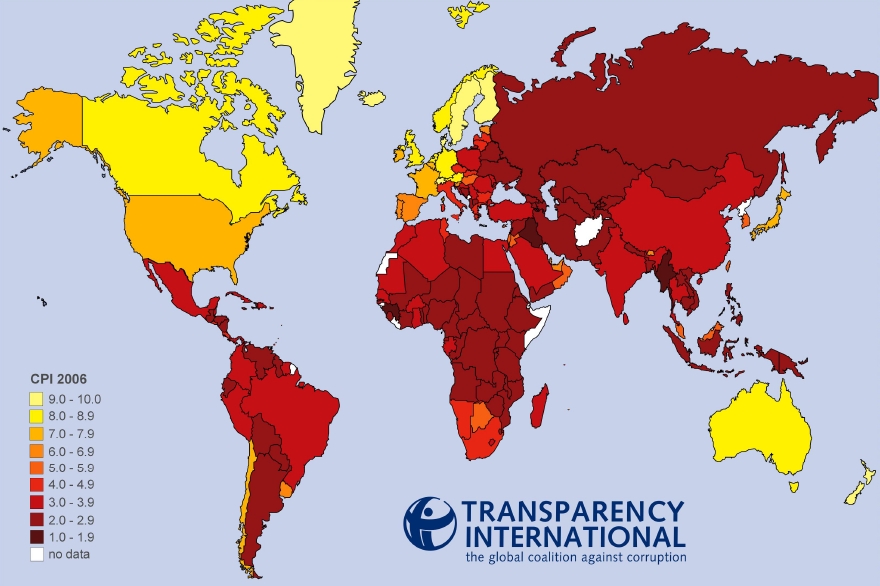
Development: 2006 Corruption Perceptions Index (CPI)


The 2006 Corruption Perceptions Index (CPI), launched today by Transparency International (TI), points to a strong correlation between corruption and poverty, with a concentration of impoverished states at the bottom of the ranking. The CPI reinforces the link between poverty and corruption. It shows the machinery of corruption remains well-oiled, despite improved legislation. “Corruption traps millions in poverty,” said Transparency International Chair Huguette Labelle. “Despite a decade of progress in establishing anti-corruption laws and regulations, today’s results indicate that much remains to be done before we see meaningful improvements in the lives of the world’s poorest citizens.”

The 2006 CPI is a composite index that draws on multiple expert opinion surveys that poll perceptions of public sector corruption in 163 countries around the world, the greatest scope of any CPI to date. It scores countries on a scale from zero to ten, with zero indicating high levels of perceived corruption and ten indicating low levels of perceived corruption. Almost three-quarters of the countries in the CPI score below five (including all low-income countries and all but two African states) indicating that most countries in the world face serious perceived levels of domestic corruption. Seventy-one countries - nearly half - score below three, indicating that corruption is perceived as rampant. Haiti (the lowest score at 1.8), Guinea, Iraq and Myanmar share the last slots. Finland, Iceland and New Zealand share the top score of 9.6. The usual suspects share the top ten positions (i.e. the Scandinavian countries, the Netherlands, Switzerland...). The UK comes in number 11, France in 18th place together with Ireland, Belgium comes 20 together with Chile and the USA (down from 17 in 2005). Spain 23rd, Portugal 26th, Italy 45th and Greece 54th. The worst European Union country is Romania in 84th place (!) but closely followed by Poland in 61st place (while Cuba comes 66th, China 70th and Russia 121st). All in all, no big surprises...

Check the whole list bellow:
http://www.transparency.org/news_room/in_focus/cpi_2006/cpi_table

18 octobre 2006

Development: Food emergency in 40 countries

The FAO’s latest assessment shows that 40 countries are facing food emergencies and require external assistance. The most pressing humanitarian problem remains the crisis in the Darfur region of Sudan. The already precarious food supply situation may worsen if deteriorating security disrupts the main harvest due to start in the coming few weeks. The situation may deteriorate also due to negative prospects for the 2006 world cereal harvest. Exceptionally hot and dry weather is adversely affecting the wheat crops in Australia, Argentina and Brazil, while drier-than-normal weather in parts of South Asia is also raising some concern for the second 2006 crop. Some of these situations may be considered the result of climate change.

Development: the myth of bio products?

En s'attaquant au "mythe des produits bio", le magazine new- yorkais BusinessWeek jette le doute sur un marché en plein boom aux Etats-Unis, et aussi en Europe d'ailleurs. Il y a quatre ans, un label "USDA Organic" a été mis sur le marché : les ventes ont aussitôt explosé. Mais ce succès a un coût, la mise en péril des idéaux initiaux des tenants du bio. Le magazine en donne pour exemple le yaourt Stonyfield, dont l'emballage représente une vache en train de paître dans une prairie verdoyante. Le message est clair : une vache en liberté garantit un produit sain, élaboré dans une exploitation familiale, loin de toute pression de l'industrie agroalimentaire.

Malheureusement, la réalité est parfois tout autre, atteste BusinessWeek. Ces yaourts Stonyfield sont produits dans une usine située près d'un aéroport, dans le New Hampshire. Et bientôt ils seront même produits à partir de lait "bio" néo-zélandais, réduit en poudre et acheminé par bateau aux Etats-Unis. Il semble que la firme importe aussi des fraises de Chine, de la purée de pommes de Turquie, des bananes d'Equateur... des pays pas forcément réputés pour leur respect de l'environnement et la protection de leurs travailleurs.
Donc, jusqu'à quel point peut on avoir confiance dans les "bio labels"? peut on avoir confiance dans les certificats de conformité, les contrôles de qualité? Ou s'aggit il encore une fois et tant seulement de nouveaux marchés pour des industries avides de recettes?

(lu dans Le Monde digital)

Development: patents in the world

The number of registered patents in the world has nearly doubled in ten years. Yet this is not happening in Europe, but due to the fast growth in Asia: WIPOs report (World Intellectual Property Organization). The growth was of 268 % in South Korea and 488 % in China. Europe is continuing to lag behind the US and Japan. And forget about Portugal's contribution, or even that of Spain, still not too bad in european terms.

11 octobre 2006

Development: Intermón Oxfam analyses 50 years of development and disparities in the world

According to the Spanish non-governmental organization Intermon Oxfam, the number of poor people in the planet has diminished during the last 50 years, yet it has increased by 140 million in sub-Saharan Africa. In the coming years, one out of three youth in black Africa will not have an employment. The NGO is organizing an international conference in Madrid to promote the fight against poverty.

Read further:
http://www.intermonoxfam.org/page.asp?id=2005&ui=7807
http://www.oxfam.org/en/

05 septembre 2006

Development: Brazil's competitiveness indicator

According to Brazil's FIESP (Federation of industries of the State of São Paulo) report on world competitiveness and its indicators, Brazil is not getting more competitive in the world.

The report assesses data collected for 43 countries, which represent 95% of the world's GDP over a period of eight years (1997-2004) from organizations like the World Bank, the UN, the world economic Forum and even the CIA. Without surprise, the United States and Japan come at the top of the list with values of 93.3 and 77 respectively, while Argentina is number one in Latin America with a note of 38.8. Brazil, however, with only 21.6 figures among the six most badly placed countries (38th place). It is only first to the Philippines (16.1), Colombia (15.0), Turkey (14.4), India (11.5) and Indonesia (7.6).

The countries are classified according to four levels of competitiveness: "high", "satisfactory", "average" and "low". The two best Latin-American countries are Argentina and Chile (of course!), coming in the third "average" category, together with countries like the Czech Republic, Italy, Spain and Portugal as well as China and Russia. Germany, France and the United Kingdom come in the second category described as "satisfactory", while the US, Japan, Sweden, Norway and Singapore top the list.

The factors taken into account in the study relate to the country's economy, the government, the capital, the infrastructures, technology development, the international trade, the companies and the human capital. The Federation stresses that there is "a clear relationship between the indicator of competitiveness and the per capita income of a country, measured in purchasing power parity in dollars". In addition the most competitive countries are those which show the highest level of the UN's human development index.