10 novembre 2006

Citizenship: 7 USA states go step backwards as regards Human rights

Gay marriage is one of the most polarising issues in the United States. Actually there is notonly a division between the democrats and the republicans, also between the consevative and the more modern/ democratic states. On tuesday, while the north-american people massively voted for the democrats for the Congress, allowing them to win the House of Representatives and the Senate, several referendums were held in 8 states to ban gay marriage! (yes, you read well, those votes were not meant to give more civil rights, but instead to take them!). The map above outlines the state of the law across the USA. Intense debates have surrounded the issue in the different states.

On 7 November, Arizona voters rejected an amendment to the state constitution that would have banned domestic partnership laws as well as gay marriage. It became the first state to reject such an amendment. But Arizona already had an ordinary law banning gay marriage, which remains in force. On the same day that the Congress changed hands, seven other states approved constitutional amendments banning gay marriage - Colorado, Idaho, South Carolina (by 78%!), South Dakota, Tennessee (81%!) Virginia and Wisconsin.

Yes, while some countries move forward towards democracy and improved human rights, like Mexico, some USA states move backwards... They call it "development", I call it social lagging behind, mental "underdevelopment".

Development: The 2006 Human Development Report is out

The 2006 Human Development Report was made public yesterday in Cape Town. As regards the HDI (human development index), the situation hasn't changed much in relation to previous years, with Norway presenting the highest HDI, the "usual suspects" in the first places (Scandinavian countries, Iceland, Netherlands, Switzerland, USA, Canada, Ireland), Belgium comes 13 (hard to believe…), before Denmark, in 15 (life expectancy is to blame). France comes 16, Italy 17, UK 18, Spain 19, Germany 21, Portugal 28. In Latin-America Argentina comes unsurprisingly first in 36, followed by Chile in 38, Uruguay 43, Costa Rica 48 and Mexico 53. Brasil only comes 69. In the European Union (EU) the last are Bulgaria and Romania (in 54 and 60th place respectively), also without surprise...

The theme for this year's report is the World water and sanitation crisis, which, according to the UN, urgently need a Global Action Plan. The 2006 Report calls for 20 litres of clean water a day for all as a human right. It calls for a Global Action Plan (under G8 leadership – but I ask why not under UN leadership???, which legitimacy does the G8 have?…), which is urgently needed to resolve a growing water and sanitation crisis that causes nearly two million child deaths every year. According to this year's report, entitled Beyond scarcity: Power, poverty and the global water crisis, across much of the developing world, unclean water is an immeasurably greater threat to human security than violent conflict.

More than 2.6 billion people still lack access to proper sanitation, and 1.1 billion people have no regular access to clean water. As a result, 1.8 million children die from diarrhoea each year, making the disease the second-largest cause of global child mortality. Almost 50 percent of all people in developing countries are also suffering at any given time from a health problem caused by a lack of water and sanitation. To add to these human costs, the crisis in water and sanitation holds back economic growth, with sub-Saharan Africa losing five percent of GDP annually—far more than the region receives in aid.

Yet unlike wars and natural disasters, this global crisis does not galvanise concerted international action, says the 2006 Human Development Report (HDR). “Like hunger, it is a silent emergency experienced by the poor and tolerated by those with the resources, the technology and the political power to end it,” says the Report. With less than a decade left to reach the Millennium Development Goals (MDGs) by 2015, this needs to change, stress the authors.

The report also says that world sanitation crisis causes millions of avoidable deaths and contamination from human waste is largely to blame. Simply installing a flush toilet in the home increases by almost 60 percent a Peruvian child’s chances of surviving to her first birthday, according to data in the 2006 Human Development Report documenting the often-fatal consequences of inadequate sanitation in developing countries. The Report shows that the efficacy of human-waste disposal is one of the strongest determinants of child survival around the world.

The cruel irony is that across the world, the poor are forced to pay much more for clean water than their affluent neighbours. The report notes that in the slums of Nairobi the poor pay five to 10 times more per litre of water than wealthy people living in the same city. The poorest households of El Salvador, Nicaragua and Jamaica spend on average over 10 percent of their income on water; in the United Kingdom, by contrast, spending more than three percent of family income on water is considered an economic hardship. And the longstanding public-versus-private debate on water will not bring prices down, stresses the 2006 HDR. In recent years, public debate on water-delivery policy in developing countries has been dominated by a polarizing discussion on privatization versus public ownership. But the authors argue that this is a false choice, diverting attention from the ultimate goal of finding viable ways of getting potable water to those who can least afford to pay.

Fianlly, also poor farmers face double water crisis: climate change and competition. The report claims that stronger rights, better irrigation and adaptation to global warming can avert catastrophe - if they arrive in time.

Read further: http://hdr.undp.org/hdr2006/

Cinema: Babel, the film


I've just seen the film "Babel". Liked it and hated it, for its actors, for the length, for its unlikely intertwined story(ies) and its "alternative pacifist message"... however it is worthwhile seing, I guess. Review will follow soon.
As is indicated in wikipedia and according to the bible, the Tower of Babel was being built by Humanity to reach heaven. Because mankind was said to be inherently evil and disobedient, instead of worshipping the God who created them, God would have stopped their efforts by creating different languages so that the builders could not understand each other. As a result of the communication problem, it would be impossible to continue and the Babel Tower would never be finished. This story is used to explain the existence of the different languages.
The film "Babel" is also about communication... or rather, the lack of it or the difficulty to communicate between people and cultures.

09 novembre 2006

Politics: The George W. Bush & co. era comes to an end

US Defence Secretary Donald Rumsfeld is to resign as the Republicans lost control of the House of Representatives, and Senate power hangs on a tight race in the state of Virginia (where it seems they are also likely to lose). On tuesday, the Democrats have not only won the House of Representatives but may also have achieved what was nearly unthinkable... win the Senate. On tuesday President Bush's Republican Party paid the price at the polls for the desastrous policies of the Bush administration in Iraq and at home. Yet, it will have taken some six years to defeat them, and in the meantime the Bush administration will be in power for 8 year. How was this possible?

The resignation of the US Defence Secretary Donald Rumsfeld shows how much the Bush administration is in disarray about Iraq. As Stephen D. Julias and Max Fraad Wolff wrote in an article published in the Asia Times, the US should be ready now "to face the world anew". I say the Bush adminisytration is forced to change attitude in order to survive and so that the Republican party might have any chance in the coming presidential elections.

Julias and Wolff wrote in the Asia Times, "The George W Bush era began with withdrawal from multilateral agreements and lively pronouncement of Pax Americana's historical mission and might. Allies were icing on a global cake of the United States' baking and for the United States' eating. This was to be showcased to a timid world by ending "rabid" Middle Eastern regimes bent on the acquisition of weapons of mass destruction (WMD) and blessing minions with the virtues of democracy. This vision, mission and method have now failed so dramatically as to be unsustainable for the US president and his remaining allies." (...) "Once it hurts the US domestic base and, thus, re-election prospects, it's time for a change. Sacrifice remains the duty of others." (...)

And they continue "The Iraq Study Group, co-chaired by Baker and Lee H Hamilton, will conclude that the US needs to make deals with Syria, Iran and the rest of a timid world to assure that the US can escape Iraq without a total loss of its long-term interest. Gone will be the stated policy of liberty and democratic revolution in the Middle East. The continued economic costs in lives, prestige and perceived omnipotence are simply unacceptable. A new, cost-controlled cooperative agenda will be announced as allowing the US to meet its real central objectives and move on to victory in the "war on terror". "

"Why the change?", they ask. Simply because "The war in Iraq and its subsequent nation-building exercise have created a direct cost to the American taxpayer of about US$340 billion to date. Not only has this large investment not yielded the promised returns, the costs sunk in this situation are climbing with every continued minute of the United States' involvement." And it goes on: "The human costs are staggering. This is true for US forces, contractors and families and for Iraqis in general. Economist Brad DeLong estimates that for every month the war in Iraq is extended, the human bill is about 100 American soldiers killed, 500 American soldiers maimed and perhaps 4,000 Iraqis dead. ". Yet these are low estimates (see previous post on estimates for the number of deaths in Iraq made by Lancet magazine).

"In short, the US federal government has overspent and over-borrowed like there was no tomorrow." (...) "Although the details of the war's costs or the nation's overall financial position may not be general knowledge, every American senses that something is profoundly wrong. This unease takes palpable form in nightly pictures broadcast from Iraq and stagnating middle-class paychecks in the face of skyrocketing bills. Voter concern is clearly demonstrated in state reporting of record voter registrations for the traditionally low-turnout mid-term elections."

"The United States today is perceived as a superpower in decline having failed in Iraq, abandoned allies and forsaken its democratic principals. This demands and will get a radical strategic change no matter which party emerges dominant from the mid-term elections. The war in Iraq has become a focal point of anger for the average American voter and throughout the world. Anger over income, opportunity and wage inequality in the United States and US economic and political decision-making around the world are now focused on Bush and US action in Iraq. This has finally become clear to business and political leadership."

On tuesday the feelings of the North-american voters becamle clear and the departure of Rumsfeld is also a sign that finally things are getting clear to the political leadership, i.e. the Republicans. Bush will be forced to change policies and maybe focus more on internal politics. The task in the coming years up to the presidential elections will be hard though... But what can change? The Iraq Study Group will probably take over Iraq planning and advising. New policy options will certainly have to contradict the rhetoric of establishing democracy in Iraq. The US will get back to multilateral diplomacy and will propbably have to engage in talkings with countries like Syria and even Iran. Things will change, they have to change, yet it will take time to make up for the time lost.

Julias and Wolff conclude: "The US will attempt to refocus global and domestic attention and rebuild. (...) Given the sensitive state of the US macroeconomy, looming government budget issues and America's diminished power position in the Middle East, there is no real other choice. Thus we conclude that a dramatic policy shift is certain and the most important outcome of the mid-term elections."

Read further:
"
Shift coming in US policy on Iraq", Christian Science Monitor article.

Politique: Rumsfeld OUT !!! (at last!)


Politique: GRANDE DEFAITE POUR BUSH AU CONGRES (ET AU SENAT)!


07 novembre 2006

Politique: 170 Etats se réunissent au Kenya pour la conférence de l'ONU sur le climat


Politique: L'Agence internationale de l'énergie appelle le monde à miser sur le nucléaire


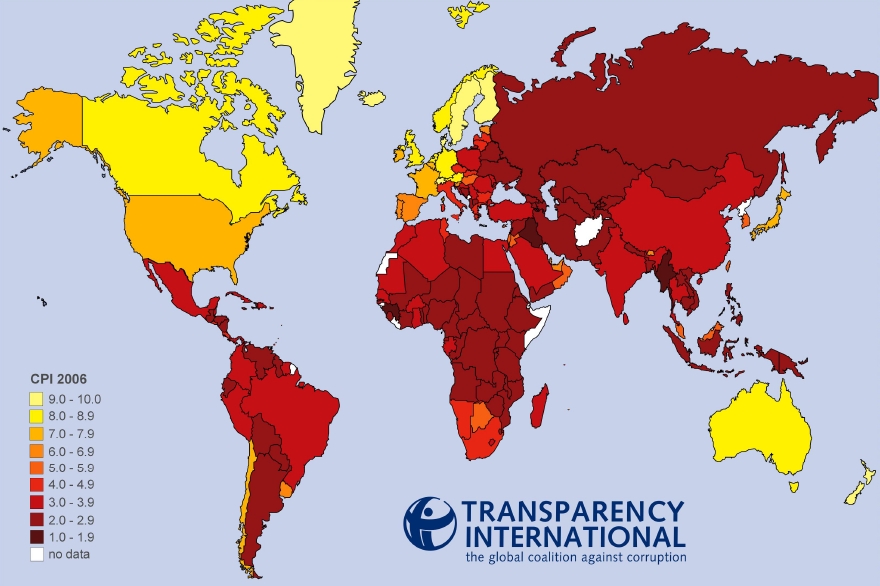
Development: 2006 Corruption Perceptions Index (CPI)


The 2006 Corruption Perceptions Index (CPI), launched today by Transparency International (TI), points to a strong correlation between corruption and poverty, with a concentration of impoverished states at the bottom of the ranking. The CPI reinforces the link between poverty and corruption. It shows the machinery of corruption remains well-oiled, despite improved legislation. “Corruption traps millions in poverty,” said Transparency International Chair Huguette Labelle. “Despite a decade of progress in establishing anti-corruption laws and regulations, today’s results indicate that much remains to be done before we see meaningful improvements in the lives of the world’s poorest citizens.”

The 2006 CPI is a composite index that draws on multiple expert opinion surveys that poll perceptions of public sector corruption in 163 countries around the world, the greatest scope of any CPI to date. It scores countries on a scale from zero to ten, with zero indicating high levels of perceived corruption and ten indicating low levels of perceived corruption. Almost three-quarters of the countries in the CPI score below five (including all low-income countries and all but two African states) indicating that most countries in the world face serious perceived levels of domestic corruption. Seventy-one countries - nearly half - score below three, indicating that corruption is perceived as rampant. Haiti (the lowest score at 1.8), Guinea, Iraq and Myanmar share the last slots. Finland, Iceland and New Zealand share the top score of 9.6. The usual suspects share the top ten positions (i.e. the Scandinavian countries, the Netherlands, Switzerland...). The UK comes in number 11, France in 18th place together with Ireland, Belgium comes 20 together with Chile and the USA (down from 17 in 2005). Spain 23rd, Portugal 26th, Italy 45th and Greece 54th. The worst European Union country is Romania in 84th place (!) but closely followed by Poland in 61st place (while Cuba comes 66th, China 70th and Russia 121st). All in all, no big surprises...

Check the whole list bellow:
http://www.transparency.org/news_room/in_focus/cpi_2006/cpi_table

06 novembre 2006

Cinéma: Festival Cinéma Méditerranéen à Bruxelles


Le 9ème Festival du Cinéma Méditerranéen à Bruxelles ouvrira ses portes du 23 novembre au 2 décembre 2006. Le festival a eu lieu pour la première fois en 1989 et depuis n'a plus cessé d'attirer du public. Il propose cette année 70 films en 10 jours, évoquant plus de 20 pays du bassin méditerranéen. Selon les organisateurs "le festival Cinéma Méditerranéen à Bruxelles diffère des autres festivals dans la mesure où , par le biais de son ambiance, il favorise le dialogue multiculturel, il rapproche les professionnels d'horizons complètement différents tout en privilégiant les rencontres entre ceux-ci et un public chaleureux et enthousiaste, dans un esprit de fête et de convivialité."

Ils prétendent "sortir de l'ombre le cinéma du soleil". Le festival "se veut un lieu où règnent la passion des découvertes, le désir de rencontre et une sérénité bien nécessaire alors qu'un vent de folie souffle sur certaines rives de la Méditerranée."

Allez-y!

Arts: Festival des libertés


"Résister à la panique sociale"

"Les peurs envahissent de plus en plus notre quotidien. Elles conditionnent et déterminent chaque jour davantage certaines opinions et certains comportements dans notre société. Ici, comme ailleurs, dans un monde dont on ne songe plus qu’à se protéger, rester chez soi est devenu une règle. Fuir les rassemblements, un réflexe. Respecter les consignes sécuritaires, un code de conduite. Cette mentalité relayée par les médias et la presse populaire, renforcée par le discours politico-alarmiste, construit progressivement dans les opinions l’acceptation tacite d’un nouvel ordre public, dont l’esprit peut faire craindre pour le devenir des libertés et des valeurs collectives. Une situation qui, si rien n’y fait, pourrait conduire à terme à l’ébranlement de la base sociale et du fondement démocratique de notre société. Soucieuse d’alerter de ce danger, l’édition 2006 du Festival des Libertés invite à l’engagement dans une résistance à la panique sociale, par l’information, le débat, le cinéma, le théâtre et la musique. Le tout dans un cadre redéfini pour favoriser le questionnement et la déconstruction. Par le jeu, la rencontre ou la découverte. Le programme du Festival des Libertés est la traduction artistique, philosophique, sociale et culturelle de son message politique. Diversité des expressions et des formes, mélange des genres, des styles et des tons. Mariage des harmonies et des paradoxes. Fusion des climats, rencontre du familier avec l’insolite dans une même convergence de sens à illustrer et à faire partager."
Du 9 au 18 novembre au Pathé Palace, à Bruxelles.

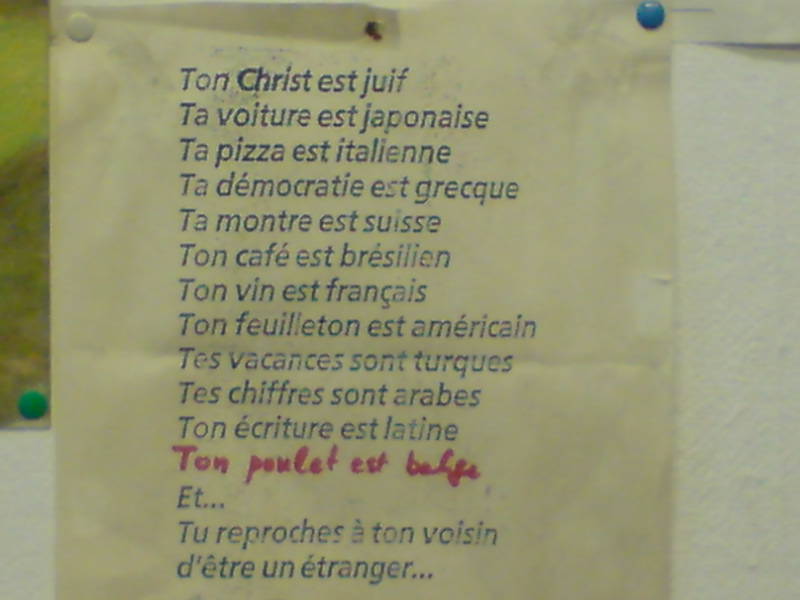
Citoyenneté: "étranger" pas égal à "étrange"

Nous sommes tous des étrangers quelque part, nous appartenons tous à une ou autre minorité à un moment ou autre... / we are all a foreigner somewhere in this world and we all belong to one or more minority...

28 octobre 2006

Poem: "Here's to life" - song by Shirley Horn


Here’s to life

<<

No complaints and no regrets
I still believe in chasing dreams
And placing bets
But I have learnt that all you give
Is all you get
So give it all you’ve got.

I had my share, I drank my fill
And even though I’m satisfied, I’m hungry still
To see what’s down another road, beyond the hill
And do it all again

So here’s to life
And every joy it brings
So here’s to life
To dreamers and their dreams

It’s funny how the time just flies
How a love can go from warm hellos to sad goodbyes
And leave you the memories you’ve memorised
To keep your winters warm

For there’s no yes in yesterday
And who knows what tomorrow brings or takes away
as long as I am still in the game
I want to play, for laughs, for life, for love

So here’s to life
And every joy it brings
So here’s to life
To dreamers and their dreams

May all your storms be weathered
And all that’s good get better
Here’s to life,


here’s to love,

here’s to you

>>


check the song here:

http://www.vervemusicgroup.com/product.aspx?ob=disc&src=art&pid=9707

Politique: Brasil/Lula: le mal moindre ou la continuation de l'espoir?

Luiz Inácio Lula da Silva (Lula), se maintient en tête des sondages réalisés au Brésil, la veille du second tour des élections. Lula (du Parti des Travailleurs, PT) réuni 61% des intentions de vote, contre 39% pour le candidat du Parti de la Social-Démocratie Brésilienne (PSDB), Geraldo Alckmin. Après un premier tour décevant pour Lula, il semble plus que jamais proche d’assurer la victoire aux présidentielles, malgré des scandales de corruption et les coups de théâtre préélectoraux. Lula qui affirmait récemment lors d’un comice électoral "je connais vos problèmes, je sais ce qu’il est de chercher du boulot pendant un an et demi, j’ai déjà été comme vous, sans argent».

Il y a quatre ans, l’élection de Lula a représenté un espoir, non seulement pour les brésiliens mais pour toute l’Amérique latine et le monde. Mais, après quatre ans de pouvoir, qu’ont Lula est le PT fait pour les brésiliens, quels ont été les résultats de leurs promesses ? Méritent ils un deuxième mandat?

Coté économie, Lula a su calmer les marchés financiers du Brésil et le capital investisseur, qui craignaient l’arrivée de la gauche au pouvoir. L’ex-syndicaliste a gagné leur confiance (certains disent qu’il s’est allié au capital et au pouvoir économique…) et suivi la politique financière orthodoxe de son prédécesseur, Cardoso. Malgré tout la croissance économique est restée modeste, ne passant de 0,5% en 2003 qu'à seulement 2,3% en 2005, trop peu pour un géant économique comme le Brésil qui a besoin d’une grande croissance créatrice d’emploi pour les millions de chômeurs. Le chômage a quand même diminué entre 2003 et 2005, de 9,73% à 9,3% (mais cette période a aussi été une période de croissance mondiale). Lula a quand même crée plus d’emplois en trois ans et demi que Cardoso en huit (les cycles économiques l’ont bénéficié), mais beaucoup moins que les 10 millions qu’il avait promis.

Coté politique de cohésion sociale et de redistribution, les choses se sont améliorées, mais pas encore assez. Il faudra encore prouver si les améliorations introduites n’ont été que purement esthétiques et anesthésiques plutôt que structurelles et durables. Entre 2003 et 2005 la pauvreté s’est réduite de 26,7% à 22,7% (% de la population sous le seuil de pauvreté), encore environ un quart de la population. Et les inégalités sociales et économiques au Brésil restent toujours parmi les plus grandes de la planète – les 10% plus riches détiennent environ 45% des revenus, tandis que les 50% plus pauvres n’ont que 14% du revenu du pays. Selon les analystes, pour redistribuer effectivement il faudra des changements structurels que le gouvernement de Lula n’a pas osé faire, il faudra affronter les banques, les grands propriétaires de la terre et le capital. Les banques (comme partout d’ailleurs) ont vu leurs profit s’accroître, et les latifondiaires ne sont pas inquiets…

La réforme agraire, pourtant drapeau électoraliste de Lula, n’a pas vraiment avancé. Même si le gouvernement affirme avoir distribué des terres à quelques 206.000 familles, la plupart de ces terres se trouvent en Amazonie, sans infrastructures ni services publics, dans les pires régions du pays. Le problème a été contourné, donc. D’un autre coté il semble que le gouvernement a augmenté beaucoup le crédit à l’agriculture familiale, ce qui est positif. Quatre ans c'est aussi trop peu pour changer radicalement les politiques, sans bouleversements majeurs.

Mais alors, qu’a fait Lula pour plaire à ce quart de la population le plus pauvre, garantissant leurs votes ? Le gouvernement a créé un programme d’aide sociale financière directe aux familles les plus démunies, la bourse famille (bolsa família), une sorte de revenu minimum. Avec ce programme (le principal programme social du gouvernement) une aide moyenne de 61 reais (environ 22 Euros) est accordée par mois à quelques 11 millions de foyers qui vivent sous le seuil de la pauvreté. Ceci permet à beaucoup de gens, surtout dans le pauvre et très peuplé Nordeste, avec de familles nombreuses, d’avoir au moins un repas par jour. Cette bourse ne coûte pas cher – seulement 0,5% du PIB brésilien – a le mérite d’aider les pauvres et surtout de garantir une partie substantielle des votes [heureusement que le vote au Brésil n’est pas encore proportionnel au revenu moyen des citoyens…]. Mais, le grand défi est de donner à cette partie de la population les moyens de s’en émanciper, de trouver ou créer un emploi. Et ça reste le grand défi du gouvernement Lula pour les quatre années à venir. Je n’oublie pas une scène vue à la télévision il y a quelques jours, je crois que dans la ville de S. Paulo : des foules de gens qui faisaient la queue et « luttaient » pour arriver les premiers et postuler pour quelques postes de caissière ou quelque chose d’équivalent… du jamais vu.

Ce que le Brésil a vraiment besoin est d’une politique de cohésion économique et sociale à l’image de celle qu’a l’Union Européenne. Cette politique a le mérite non seulement de redistribuer la richesse, en quelque sorte, les richesses des régions les plus riches vers les plus pauvres, mais de le faire en aidant à créer les conditions structurelles pour que ces régions se développent et créent des emplois elles mêmes. Il ne s’agit seulement pas de donner du poisson, mais d’aider à apprendre à pecher… Et coté régions, le Brésil a aussi d’énormes disparités, le sud étant nettement plus riche que le nord et le Nord-est (Nordeste). L’état de S. Paulo, par exemple, qui n’a que 21,5% de la population, représente à lui seul plus de 40% du PIB brésilien.

Coté égalité des chances, le gouvernement a aussi fait quelque chose, créant le Secrétariat Spécial de Politiques pour la Femme, un des premiers projets de Lula, responsable de l'augmentation du salaire et de la participation des femmes dans le marché de travail. Selon données de l'Institut Brésilien de Géographie et de Statistique, en 2001 il y aurait environ 35 millions de femmes économiquement actives, total qui est monté à environ 40 millions en 2004. Lula a aussi lancé la Central de Atendimento à Mulher (centrale d’aide à la femme), une ligne téléphonique gratuite qui aide les victimes de violence domestique pendant 24 heures (problème grave au Brésil). Et finalement la Loi Maria da Penha a été approuvée, qui détermine la prison de trois mois à trois ans pour agression à la femme et annule toute procurations au nom des conjoints.

Si coté corruption, les choses n’ont pas été brillantes, avec plusieurs scandales de détournement de fonds (souvent pour le financement du parti de Lula, le PT), plusieurs collaborateurs de Lula ayant été accusés et mis en prison, rien n’a jamais été trouvé contre Lula lui-même. Comme le mentionne des analystes, au moins aujourd’hui la corruption est investiguée ce qui n’était pas le cas avant, et puis tous les partis la pratiquent… L’exemple de la Suède est encore loin, où les ministres sont obligés de démissionner quand ils ont "oublié" de payer l’impôt de télévision…

Coté politique internationale, Lula a suivi un peu l’exemple de la politique économique, manoeuvrant sagement entre les différentes eaux et courants… assumant certes une indépendance et ton critique vis à vis de l’administration nord-américaine de Bush, participant activement au mouvement des non-alignés, mais restant assez low-profile et très pragmatique, au contraire d’autres leaders sud-américains comme Hugo Chavez ou son voisin Evo Morales. Tout récemment Lula a même tenu a affirmer son indépendance et voie unique, en quittant diplomatiquement l’appui à la candidature du Venezuela au Conseil de Sécurité des Nations Unies et en exigeant un traitement correct et faisant pratiquement un ultimatum au gouvernement Bolivien, au sujet de l’entreprise brésilienne Petrobras (investisseur dans le pétrole et gaz naturel), que Morales menaçait de nationaliser.

Lula gagnera très probablement les élections de dimanche, mais il aura une grande responsabilité et opportunité unique envers le peuple brésilien. On verra dans quatre ans, ce que Lula et son PT auront fait de ce capital d’espoir…

On espère que ce ne soit que des "cuentos chinos", comme le décrit Andrés Oppenheimer, dans son livre "Cuentos Chinos, el engaño de Washington, la mentira populista y la esperanza de América latina" (Editorial Sudamericana, Buenos Aires, 2005). Dans ce livre il se demande si les nouveaux régimes de gauche en Amérique latine réussissent vraiment à réduire la pauvreté et améliorer les conditions de vie de la population ou si, par contre, ces gouvernement s ne font que raconter des histoires de Chine… (mensonges…). Mais il reste plutôt positif.

Espérons que la phrase que cite Oppenheimer dans son livre ne se vérifie pas: "le Brésil est le pays du futur, et il le restera toujours".

Music: TRACKLIST October 06


Album of the month:

Trentemøller – “The last resort”
With this double cd, danish musician Anders Trentemøller walks his own path away from the pokerflat label where he started with a remix for Royksopp. The first CD is instrumental electronic music with an atmospheric and organic taste, evoluting from the previous electro-minimal Trentemøller’s work. Yet, tracks like “Polar Shift’, ‘Rykketid’ and ‘Killer Kat’ may make you feel like dancing. This reminds a bit of Nathan Fake but is less techno and more dancefloor. A great CD which is to be listened in one long go. The second CD has some remixes and different versions.
"Anders Trentemøller has taken the underground scene by storm over the last few months with such incredible tracks as 'Beta Boy', 'Polar Shift' and 'Sunstroke', not to mention his remixes of artists ranging from The Knife and Yoshimoto through to the Pet Shop Boys. He's become one of the leading producers in a considerably short space of time, and now is due to release his debut artist album 'The Last Resort' on Poker Flat. Due for release in October, and preceded by lead single 'Always Something Better', this is one to mark on the calender as it is definitely not to be missed." >>> http://www.progressive-sounds.com/features/Trentemoller-The-Last-Resort.asp

Other albums:

Agoria
– “The Green Armchair”
Ame... Mixing – “various”
Burial – “Burial”
Hey Willpower – “P.D.A.”
Lindstrøm – “It's a Feedelity Affair”
Luomo – “Paper Tigers”
Mummer – “SoulOrganismState”
Radio Slave – “Creatures of the Night”
Rub-n-Tug –“Better With A Spoonful Of Leather - aNYthing Mix Volume II”
Secret Love 3 Compiled By Jazzanova & Resoul - compilation
Small Sins & Thomas D'Arcy – “Small sins”
TM Juke – “Forward”

Track of the month:

Ooze & Ooze feat. Tishk – “Random Wondrous Things”

Other tracks of the months:

Âme – “Rej (Original Club Mix)”
Bertine Zetlitz – “Midnight”
Black Devil Disco Club – The devil in us”
Chica and the Folder – “I’ll come running”
Dark Globe featuring Boy George – “Atom”
François Dubois – “Blood (Original Mix)”
Grandadbob – “Pictures (Naughty Dub)”
Hey Willpower - “Phenomenon”
Liebe*Detail 13 – “Liebe*Detail 13”
Ludovic Vendi – “Hectorine (Alland Byallo Remix)”
Lushlife – “smile”
Mai – “Snowing downtown”
Martin Buttrich – “Full clip”
Micah P. Hinson & Viva Voce – “Pleasant Street”
Michoacan – “2 Bullets”
Moby – “Go (Trentemøller remix)”
Oliver Huntemann & Stephan Bodzin – “37 Grad (Arnaud Rebotini's Blackstrobe Remix)” Phonique – “River (Robert Babicz Remix)”
Putsch '79 – “kisses”
TM Juke - "Life, Rain, Fall"

Arts: MODO BRUXELLAE 2006


Modo Bruxellae parcours de stylistes 2006: from 27 to 29 October 2006
The Brussels fashion scene is growing. Though still not as well known as Antwerp, Brussels has also scored recently as a creative fashion center. The arrival of the so-called fashion movement of the “Antwerp Six” - Ann Demeulemeester, Walter van Beirendonck, Dirk van Saene, Marina Yee, Dirk Bikkemberg and Dries van Noten, all graduates of the Antwerp Fashion Academy - nearly 20 years ago, together with Martin Margiela, placed Belgium on the global fashion map.

Modo Bruxellae was born ten years ago as a showcase to raise awareness for Brussels’ fashion designers. By then Brussels wasn’t known as a fashion center, yet it already had talented designers like Olivier Strelli, Delvaux, Donaldson and others. With new talents coming out of designer school La Cambre, shops started opening and selling works by local designers, like the shop “Stijl” in 1984 in Rue Antoine Dansaert. That also boosted the local fashion scene and they would be followed by other shops in the area. Still today fashion victims move around the La Bourse area - around Rue Dansaert and Rue Léon Lepage.

“Modo Bruxellae’s job is to work alongside this organic growth to give it direction and make sure that the talent keeps on emerging. More designers than ever are choosing to set up shop in the city and a distinct fashion network is developing. La Cambre Mode is the city’s foremost visual arts college and generates the most widely recognised designers. “When speaking about fashion in Belgium, people tend to only mention Antwerp, but nowadays a lot of young designers from La Cambre are becoming as influential as their Flemish counterparts”. The best know case is that of José Enrique Oña Selfa, who worked for Spanish luxury brand Loewe for their womens’ collection, while fellow colleague Laetitia Crahay designs jewellery for Chanel and is also head designer at Delvaux. Olivier Theyskens became famous when Madonna wore one of his outfits. (…)”

The purpose of Modo Bruxellae is to generate business for the city’s fashion market. This includes the promotion of different events – including catwalk shows, exhibitions, award shows and stock sales – and also aims to engage the public as well. One of the most interesting and creative events is the annual designer trails, which invite local designers to display their clothing in various unexpected locations.

26 octobre 2006

Cinema: AzulOscuroCasiNegro / DarkBlueAlmostBlack

Si el color de tu vida no te gusta... actúa! rebélate!

Cinema: Festival Cinémas d’Espagne et d’Amérique Latine de Bruxelles


Le 14ème Festival Cinémas d’Espagne etd’Amérique Latine de Bruxelles (FestCEAL), un classique déjà, aura lieu du 6 au 21 novembre à Bruxelles.
Le Festival est un rendez-vous incontournable des cinéphiles bruxellois et attire presque 20.000 spectateurs chaque année. Il présente un échantillon assez représentatif des productions plus (et moins) récentes d’Espagne et d’Amérique Latine (Brésil inclus), cinématographies pas très présentes (ou pas assez) en Belgique. Il faut dire qu’il permet de voir des films moins commerciales qu’on n’aurait jamais l’occasion de voir en Belgique.
La quatorzième édition a sélectionné plus de 80 films, avec un programme spécifique pour le cinéma brésilien cette année.

Parmi les fims présentés, "Babel", qui a gagné récemment à Cannes - Prix de la mise en scène - (du Mexicain Alejandro Gonzalez Iñarritu et avec Gael García Bernal, Brad Pritt et Cate Blanchett), "El Laberinto del Fauno" (du Mexicain Guillermo del Toro avec Sergi López et Maribel Verdú), "Bordertown" (un film tourné à Ciudad Juárez au Mexique et interprété par Antonio Banderas et Jennifer López), "Iberia" (dernier film du réalisateur espagnol Carlos Saura), "Azuloscurocasinegro", (film espagnol primé au festival de Malaga). Au niveau de la programmation, la traditionnelle section officielle en compétition proposera désormais cinq sections, Section Cinémas d’Espagne, Section Cinémas d’Amérique latine, Section Espagne tout court, Documentaires d’Espagne et Documentaires d’Amérique Latine.

Le Festival contribue aussi à renforcer le processus de collaboration entre l’Europe et l’Amérique latine, accueillant le seul marché de longs métrages organisé en Belgique, les 9èmes Rencontres de l’Industrie Audiovisuelle, ENIFILM.

Cinema: 1er Festival du Film Arabe de Bruxelles

Le premier Festival du Film Arabe de Bruxelles est organisé du 25 au 30 octobre, au cinéma Vendôme. Selon les organisateurs "Nous voulons donner aux réalisateurs la possibilité de présenter leur oeuvre et d'éveiller la curiosité du public, de lui faire découvrir d'autres modes de vie et d'autres philosophies en mettant l'accent sur le dialogue interculturel. Nous voulons élargir l'horizon culturel des gens quelle que soit leur origine et donner au monde contemporain une perception objective et tolérante des cultures et des racines des gens originaires du monde arabe". Occasion pour voir par exemple "Le grand voyage", qui est déjà passé dans le circuit commercial à Bruxelles.
Ce premier festival rend aussi hommage à la femme réalisatrice et prévoit des rencontres autour de quelques thèmes concernant la femme.

[lu dans le magazine "cinema: se distraire à bruxelles]

22°C à Bruxelles ce jeudi !

Ce jeudi à Bruxelles (Uccle) le thermomètre a grimpé jusqu'à 22°C. Selon Meteoservices à Louvain, le dernier record du 26 octobre vient d'être brisé puisqu'il s'élevait à 21,8°C et datait de 1913! Et il a fait non seulement doux, il y avait du soleil... Quelle différence par rapport aux tempêtes, pluie et vent qui se faisaient sentir en Espagne...
Il se peut même que le mois d'octobre constitue un record à Bruxelles... en tout cas ce sera bien au dessu de la moyenne.
Eh oui, le temps n'est plus ce qu'il était... moi je me réjoui, une Belgique plus chaude ce n'est pas si mal que ça, si on peut s'asseoir en terrasse! Mais bon, 26 jours de pluie un mois d'août c'est pas bien non plus (et quelles pluies)... le problème c'est que le climat, en Belgique et ailleurs, passe des extrêmes aux autres extrêmes... de la secheresse à la pluie, de la chaleur au froid... eh bien, avec le réchauffement de la planète... Bruxelles pourrait bientôt avoir une plage! Voilà de quoi se réjouir... Moi je cherche déjà à acheter un bon terrain avec vue de mer. Je cherche seulement l'altitude la plus convenable... 50 metres? 70?...
Et puis tant puis pour le Pays Bas, le Bangladesh, Nauru, les Maldives...