AIDS in Portugal
Entretanto em Portugal, a maioria das metas dos planos de luta contra a sida não foram atingidas. Passaram 29 anos desde a detecção do primeiro caso de HIV/sida em Portugal e o país continua a ter dos piores indicadores sobre a infecção na Europa. Responsabilidade? Ninguém tem, como sempre em Portugal, é “a vida”…
De acordo com o Centro de Vigilância Epidemiológica das Doenças Transmissíveis, registaram-se em Portugal 29.461 casos de infecção pelo VIH entre 1983 e Junho 2006, mas segundo o Programa das Nações Unidas para a Sida (ONUSida), o número de portugueses infectados pelo VIH pode ser superior, estimando esta entidade que se situe nos 32 mil. Segundo indica o jornal Publico, e como revela o último relatório (2005) do Centro Europeu para a Monitorização Epidemiológica da Sida, Portugal ocupa o segundo pior lugar num grupo de 52 países europeus (junto com os menos desenvolvidos) apenas pior do que a Estónia, em número de novos casos de infecção diagnosticados por milhão de habitantes: 251 por ano, logo seguidos dos 247 da Federação Russa e 241 da Ucrânia.
Um novo Programa de Prevenção oficial para a Infecção HIV/sida entre 2007 e 2010 foi ontem, 1 de Dezembro, apresentado em Lisboa. O objectivo é reduzir, até 2010, em 25%, a mortalidade causada pela doença, diminuir o número de novas infecções e aumentar o diagnóstico voluntário, segundo os objectivos anunciados. Mas em 2010 veremos os resultados... E ninguém será responsável se os resultados forem maus. Muito dos projectos, como os centros de terapêutica combinada, ficaram pelo caminho (quem sabe se por cortes orçamentais…). O actual coordenador nacional de luta contra a sida (desde há mais de um ano no cargo!!!), Henrique Barros, admite que a maioria das metas ficou por atingir e que, nalguns casos, nem seria desejável que fossem concretizadas (comentários para quê?). O novo programa nacional de combate à sida determina intervenções na prevenção da doença junto de grupos mais vulneráveis, como os toxicodependentes e os migrantes (alguns dos mais afectados).
02 décembre 2006


01 décembre 2006
Citizenship: Stop AIDS, keep the promises!

Today, December 1, 2006, Kofi Annan passed the following message: "In the 25 years since the first case was reported, AIDS has changed the world. It has killed 25 million people, and infected 40 million more. It has become the world’s leading cause of death among both women and men aged 15 to 59. It has inflicted the single greatest reversal in the history of human development. In other words, it has become the greatest challenge of our generation."
In 2000, the World's leaders made a promise, as part of the Millennium Development Goals, to halt and begin to reverse the spread of AIDS by 2015. That has been followed by many other targets and commitments over the past six years, among which that of providing cheap treatment to people throughout the world. Many of those promises fell short of expectations. Big pharmaceutical companies still keep unacceptable rights over treatments which are not being made available at accessible prices.
Meanwhile, new reports by UNAIDS and the World Health Organization (WHO) indicate that the epidemic continues to spread in every region of the world. By now over 25 million people have died of AIDS since 1981, 2.9 million in 2006 alone. At this rate, the WHO predicts that in the next 25 years another 117 million people might die, making AIDS the third leading cause of death worldwide.
With “accountability” as the theme of this World AIDS Day on 1 December, campaigners across the globe are calling leaders to account not just for good intentions, but for action to make those promises a reality.
Meanwhile, apart from making treatments available worldwide, the only thing we can all do is to respect the people who have HIV or AIDS, to prevent the virus from spreading by USING CONDOMS and have safe se reports and test when required.
Meanwhile, new reports by UNAIDS and the World Health Organization (WHO) indicate that the epidemic continues to spread in every region of the world. By now over 25 million people have died of AIDS since 1981, 2.9 million in 2006 alone. At this rate, the WHO predicts that in the next 25 years another 117 million people might die, making AIDS the third leading cause of death worldwide.
With “accountability” as the theme of this World AIDS Day on 1 December, campaigners across the globe are calling leaders to account not just for good intentions, but for action to make those promises a reality.
Meanwhile, apart from making treatments available worldwide, the only thing we can all do is to respect the people who have HIV or AIDS, to prevent the virus from spreading by USING CONDOMS and have safe se reports and test when required.
24 novembre 2006
21 novembre 2006
Politics: 30 years of "war on terror"?
30 ans...
That is how long the "war on terror" could last, accordingto a report pubblished monday by the Oxford Research Group: "Into the Long War: Oxford Research Group International Security Report 2006". The research group is an independent non-governmental organisation, a think-tank specialised in global security issues. The report calls for a "complete reassessment of current policies". Nothing new, though, I'd say... and I thiink 30 years might be too optimistic. Its author, Paul Rogers, also Professor of Peace Studies at the University of Bradford, takes a step back from the heat of the moment to provide a concise overview of the international security situation, focussing on the 'war on terror', the related conflicts in Iraq and Afghanistan, and the implications of US and UK foreign policy for the majority world.
That is how long the "war on terror" could last, accordingto a report pubblished monday by the Oxford Research Group: "Into the Long War: Oxford Research Group International Security Report 2006". The research group is an independent non-governmental organisation, a think-tank specialised in global security issues. The report calls for a "complete reassessment of current policies". Nothing new, though, I'd say... and I thiink 30 years might be too optimistic. Its author, Paul Rogers, also Professor of Peace Studies at the University of Bradford, takes a step back from the heat of the moment to provide a concise overview of the international security situation, focussing on the 'war on terror', the related conflicts in Iraq and Afghanistan, and the implications of US and UK foreign policy for the majority world.
16 novembre 2006
Citoyenneté: USA: un Blanc américain gagne autant qu'un Noir et un Hispanique réunis
Selon l’agence (Belga) le revenu annuel médian par habitant aux Etats-Unis s'est élevé en 2005 à 29.025 dollars pour les Blancs. Il n’était que de 14.461 dollars pour les Hispaniques (originaires de l’Amérique du Sud et centrale) et 16.675 dollars pour les Noirs, selon des estimations publiées mardi dernier par le Bureau du recensement nord-américain. Cet écart ne concerne pas toutes les minorités: les Asiatiques enregistrent un revenu annuel par habitant de 27.201 dollars. Parallèlement, en ce qui concerne la pauvreté, si 13,3 % des Américains vivent sous le seuil de pauvreté, la proportion monte à 25,6 % chez les Noirs et à 22,4 % chez les Hispaniques, contre 11,5 % pour les Asiatiques et 9 % pour les Blancs. Les deux communautés les plus en difficulté partagent aussi la jeunesse - l'âge médian des USA est de 36,4 ans, mais 31,3 ans pour les Noirs et 27,2 ans pour les Hispaniques. Ils ont aussi un moindre accès à l'éducation, plus bas chez les Noirs et les Hispaniques. Bien sur, ces disparités ne sont pas un problème de race mais de classe sociale… ce que beaucoup de nord-américains ne comprennent pas…
Citizenship: South Africa approves same-sex unions
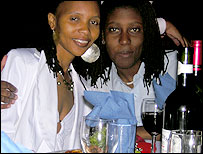 (picture from BBC news online)
Yes, while some US states move backwards, South Africa's parliament has voted this week to legalise same-sex weddings! It was the first African country to approve such unions and the fifth in the world, after the Netherlands, Belgium, Spain and Canada. The Civil Union bill was passed by 230 votes to 41. It provides for the "voluntary union of two persons, which is solemnised and registered by either a marriage or civil union". This new legislation was introduced after the Constitutional Court ruled last year that the existing laws discriminated against homosexuals. The ruling was based on the constitution, which was the first in the world specifically to outlaw discrimination on the grounds of sexual preference.
The ruling African National Congress (ANC), who has a majority in the parliament had asked all the members of parliament to vote for the law, despite the opposition of church and traditional leaders (big surprise, no?). African Christian Democratic Party leader Reverend Kenneth Meshoe has even told the parliament that those who voted for same-sex marriages would face divine wrath…
However some gay rights activists have criticised the bill, because it gives officials the right not to perform same-sex wedding ceremonies if this would conflict with their "conscience, religion and belief"… (reminds me of abortion in Portugal…).
Read further:
http://news.bbc.co.uk/2/hi/africa/6147010.stm
http://news.bbc.co.uk/2/hi/africa/6147384.stm
15 novembre 2006


14 novembre 2006
Development: Internet use in Europe
Nearly half of the people in the 25 countries of the European Union (EU25) used the internet at least once a week in 2006
>
Northern European countries (and scandinavian ones in particular) are still the most internet-friendly, more than southern european ones. Of course, the climate gives a little hand...
>
A third of households and 3/4 of enterprises had broadband internet access. Internet access increased from 48% of households in early 2005 to 52% in 2006. 32% had a broadband connection, compared to 23% in 2005. At the beginning of this year, 94% of enterprises had access to the internet (91% in 2005), and 75% had a broadband connection (63% in 2005). In 2006, 47% of the people use the internet regularly, at least once a week, whether at home or at any other location. This is the result of surveys carried out by Eurostat (the european statistical office) on the use of Information and Communication Technologies (ICT). The survey includes Norway and Iceland. The surveys also covers broadband connections, e-commerce, e-government and e-skills.
Internet access in European homes ranged from 23% in Greece to 80% in the Netherlands
The Netherlands had the highest proportion of households with internet access (80%), Denmark (79%), Sweden (77%). The lowest levels were registered in Greece (23%), Slovakia (27%) and Hungary (32%). The highest part of enterprises with internet access was in Finland (99%), Denmark and Austria (both 98%) and the Netherlands (97%). Only in Latvia (80%), Cyprus (86%), Lithuania (88%) and Poland (89%) were fewer than 90% of enterprises connected to the internet. Broadband offers a much faster connection to the internet. The Netherlands had again the highest share of broadband connection (66%), followed by the "usual suspects" Denmark (63%), Finland (53%) and Sweden (51%), and lowest in Greece (4%), Slovakia (11%), Cyprus (12%) and Ireland (13%). Amongst enterprises the highest levels of broadband connections were recorded in Sweden and Finland (both 89%), Spain (87%) and France (86%), and the lowest in Poland (46%), Cyprus (55%), Lithuania (57%) and Latvia (59%).
The internet is very popular among young people, nearly 3/4 of young people use the internet at least once a week. The highest share of individuals regularly using the internet were recorded in Sweden (80%), Denmark (78%), the Netherlands (76%) and Finland (71%), and the lowest in Greece (23%), Cyprus (29%), Italy and Portugal (both 31%). Interesting is also the fact that more men use the internet regularly than women (51% to 43%) and this disparity increases with age.
Get the results here.
>
Northern European countries (and scandinavian ones in particular) are still the most internet-friendly, more than southern european ones. Of course, the climate gives a little hand...
>
A third of households and 3/4 of enterprises had broadband internet access. Internet access increased from 48% of households in early 2005 to 52% in 2006. 32% had a broadband connection, compared to 23% in 2005. At the beginning of this year, 94% of enterprises had access to the internet (91% in 2005), and 75% had a broadband connection (63% in 2005). In 2006, 47% of the people use the internet regularly, at least once a week, whether at home or at any other location. This is the result of surveys carried out by Eurostat (the european statistical office) on the use of Information and Communication Technologies (ICT). The survey includes Norway and Iceland. The surveys also covers broadband connections, e-commerce, e-government and e-skills.
Internet access in European homes ranged from 23% in Greece to 80% in the Netherlands
The Netherlands had the highest proportion of households with internet access (80%), Denmark (79%), Sweden (77%). The lowest levels were registered in Greece (23%), Slovakia (27%) and Hungary (32%). The highest part of enterprises with internet access was in Finland (99%), Denmark and Austria (both 98%) and the Netherlands (97%). Only in Latvia (80%), Cyprus (86%), Lithuania (88%) and Poland (89%) were fewer than 90% of enterprises connected to the internet. Broadband offers a much faster connection to the internet. The Netherlands had again the highest share of broadband connection (66%), followed by the "usual suspects" Denmark (63%), Finland (53%) and Sweden (51%), and lowest in Greece (4%), Slovakia (11%), Cyprus (12%) and Ireland (13%). Amongst enterprises the highest levels of broadband connections were recorded in Sweden and Finland (both 89%), Spain (87%) and France (86%), and the lowest in Poland (46%), Cyprus (55%), Lithuania (57%) and Latvia (59%).
The internet is very popular among young people, nearly 3/4 of young people use the internet at least once a week. The highest share of individuals regularly using the internet were recorded in Sweden (80%), Denmark (78%), the Netherlands (76%) and Finland (71%), and the lowest in Greece (23%), Cyprus (29%), Italy and Portugal (both 31%). Interesting is also the fact that more men use the internet regularly than women (51% to 43%) and this disparity increases with age.
Get the results here.
Cinema: the Mexican trio
 Alfonso Cuaron, Alejandro González Iñárritu and Guillermo Del Toro are all three Mexican directors from the same generation - 61-64. They represent a new generation of Mexican directors and some of the best that Mexican cinema has offered the world in recent years. They are now centerstage of present day global cinema. Their most recent films are becoming global success stories, north-american, british or spanish expensive productions staging la creme de la creme of fashionable actors. Yet they became noticed and known with Mexican homemade productions, like "Amores Perros", "Y tu maman también" and others, having launched some nowadays famous actors like Gael Garcial Bernal. They have "left" Mexico and became global diectors. Yet I miss their Mexican films and hope they film again soon in their native country...
 Alfonso Cuaron [Children of Men (2006), Paris, je t'aime (2006), Harry Potter and the Prisoner of Azkaban (2004), Y tu mamá también (2001)…]
check:
http://www.imdb.com/name/nm0190859/
http://www.rottentomatoes.com/p/alfonso_cuaron/
Alejandro González Iñárritu [Babel (2006), 21 Grams (2003), Amores perros (2000), …]
check:
http://cinemexicano.mty.itesm.mx/directores/alejandro_inarritu.html
http://www.imdb.com/name/nm0327944/
Guillermo Del Toro [El Laberinto del Fauno (2006), aka Pan's Labyrinth, Hellboy (2004), Blade II (2002)]
check:
http://www.imdb.com/name/nm0868219/
http://www.rottentomatoes.com/p/guillermo_del_toro/
Cinema: my tips / mes suggestions
Here a list of the films that I have seen most recently and that I would recommend you, and other films that will soon come out...
Latest
>
“Babel” by Alejandro González Iñárritu with Brad Pitt, Cate Blanchett and Gael García Bernal, among other excellent actors including some non professional (****)
“The black Dahlia”, by Brian De Palma with Scarlett Johansson, Josh Hartnett, Aaron Eckart and Hilary Swank [not excellent but great decors and performances, and still a De Palma…] (**)
"Children of Men"by Alfonso Cuaron with Julianne Moore and Clive Owen, (***)
"Scoop" continuation of the London season by Woody Allen this time with Woody himself, Scarlett Johansson (again) and the glamourous Hugh Jackman (I am an unconditional fan of Woody Allen and this one was very good), (***)
“Shortbus” by John Cameron Mitchell with some cute but unknown actors… (excellent, fresh and not pornographic), (****) – as Michel Rebichon wrote in STUDIO magazine, “dans ce New York de carton-pâte post -11 Septembre, métaphoriquement plongé dans les ténèbres à la suite d’une panne d’électricité, le sexe et les corps ne sont que des véhicules pour atteindre – attention, gros mots! – l’amour et la vérité des émotions. Shortbus est un film (dé)culotté, une expérience de vie, un happening artistique, une tragi-comédie de la vie dans laquelle on vous propose chaudement de… grimper".
"Miss Little Sunshine" by Jonathan Dayton and Valerie Faris with Steve Carell, Greg Kinnear and Toni Collette among others – great fresh road comedy! (****)
"The Last Kiss" by Tony Goldwyn with Zach Braff (from the cult film “Garden State”) – I haven’t seen yet but seems interesting…
And still
>
"Bubble" by Steven Soderbergh, (***)
“Elementarteilchen” (Partcules Elementaires) by Oskar Röhler, (**)
“L’homme de sa vie” by Zabou Breitman - not seen yet but will...
"Paris je t’aime" – various (see previous post), (***)
"Thank you for smoking" by Jason Reitman with Aaron Eckart in excellent form, (***)
“The devil wears Prada” by David Frankel, only for the excellent Meryl Streep! (**)
“The science of sleep” by Michel Gondry, with Gael Garcia Bernal and Charlotte Gainsbourg – not as good and special as the previous “Eternal sunshine of the spotless mind” but quite something as well… (****)
“Voyage en Armenie” by Robert Guediguian, (***)
Last disappointment:
“Dans Paris” by Christophe Honoré with Romain Duris, reminescent of the french nouvelle vague yet not quite réussi...
Coming soon:
>
"El Laberinto del Fauno" (Le labyrinthe de Pan) by Guillermo Del Toro with Sergi López, the great Maribel Verdú (from "Y tu mama también") and Ariadna Gil among others,
“Angel” by François Ozon (one of my favourite directors!) with Romola Garai (we saw her in Scoop), Sam Neill and Charlotte Rampling – first Ozon film made in England, am very curious...
"Lady Chatterly" by Pascal Ferran.
Latest
>
“Babel” by Alejandro González Iñárritu with Brad Pitt, Cate Blanchett and Gael García Bernal, among other excellent actors including some non professional (****)
“The black Dahlia”, by Brian De Palma with Scarlett Johansson, Josh Hartnett, Aaron Eckart and Hilary Swank [not excellent but great decors and performances, and still a De Palma…] (**)
"Children of Men"by Alfonso Cuaron with Julianne Moore and Clive Owen, (***)
"Scoop" continuation of the London season by Woody Allen this time with Woody himself, Scarlett Johansson (again) and the glamourous Hugh Jackman (I am an unconditional fan of Woody Allen and this one was very good), (***)
“Shortbus” by John Cameron Mitchell with some cute but unknown actors… (excellent, fresh and not pornographic), (****) – as Michel Rebichon wrote in STUDIO magazine, “dans ce New York de carton-pâte post -11 Septembre, métaphoriquement plongé dans les ténèbres à la suite d’une panne d’électricité, le sexe et les corps ne sont que des véhicules pour atteindre – attention, gros mots! – l’amour et la vérité des émotions. Shortbus est un film (dé)culotté, une expérience de vie, un happening artistique, une tragi-comédie de la vie dans laquelle on vous propose chaudement de… grimper".
"Miss Little Sunshine" by Jonathan Dayton and Valerie Faris with Steve Carell, Greg Kinnear and Toni Collette among others – great fresh road comedy! (****)
"The Last Kiss" by Tony Goldwyn with Zach Braff (from the cult film “Garden State”) – I haven’t seen yet but seems interesting…
And still
>
"Bubble" by Steven Soderbergh, (***)
“Elementarteilchen” (Partcules Elementaires) by Oskar Röhler, (**)
“L’homme de sa vie” by Zabou Breitman - not seen yet but will...
"Paris je t’aime" – various (see previous post), (***)
"Thank you for smoking" by Jason Reitman with Aaron Eckart in excellent form, (***)
“The devil wears Prada” by David Frankel, only for the excellent Meryl Streep! (**)
“The science of sleep” by Michel Gondry, with Gael Garcia Bernal and Charlotte Gainsbourg – not as good and special as the previous “Eternal sunshine of the spotless mind” but quite something as well… (****)
“Voyage en Armenie” by Robert Guediguian, (***)
Last disappointment:
“Dans Paris” by Christophe Honoré with Romain Duris, reminescent of the french nouvelle vague yet not quite réussi...
Coming soon:
>
"El Laberinto del Fauno" (Le labyrinthe de Pan) by Guillermo Del Toro with Sergi López, the great Maribel Verdú (from "Y tu mama también") and Ariadna Gil among others,
“Angel” by François Ozon (one of my favourite directors!) with Romola Garai (we saw her in Scoop), Sam Neill and Charlotte Rampling – first Ozon film made in England, am very curious...
"Lady Chatterly" by Pascal Ferran.
Arts/architecture: "Skywalk" over the Grand Canyon West

A glass "skywalk" will be suspended some 1 220 m above the Colorado River on the very edge of the Grand Canyon and should be finished by the end of 2006. It was an initiative from the Hualapai tribe, who owns and administrates their lands west of the Grand Canyon.
The project was designed to allow people to "connect with nature while protecting the Hualapai nation, their culture and values which are deeply engraved in the the canyon walls ". The vision of the Skywalk was to enable visitors to walk beyond the canyon walls, being surrounded by the Grand Canyon while standing at the edge of the Glass Bridge. The project aimed to find a balance between form, function and nature. The Skywalk will include highlights such as a high-end café and restaurant with outdoor patio and rooftop seating on the edge of the canyon.
13 novembre 2006
Poema: O mar de Sophia
 O mar...
Quando eu morrer voltarei para buscar
Os instantes que não vivi junto do mar.
(in "Livro Sexto")
(in "Livro Sexto")
*
Não há nenhum vestígio de impureza,
Aqui onde há somente
Ondas tombando ininterruptamente,
Puro espaço e lúcida unidade,
Aqui o tempo apaixonadamente
Encontra a própria liberdade.
* *
Há muito que deixei aquela praia
Há muito que deixei aquela praia
De grandes areais e grandes vagas
Mas sou eu ainda quem na brisa respira
E é por mim que espera cintilando a maré vasa
* * *
... de poesias de Sophia de Mello Breyner Andresen
... de poesias de Sophia de Mello Breyner Andresen
*
(translation in english & french will follow...)
*
[foto tirada em Peniche, Portugal, 1/11/06]
12 novembre 2006
Politics: WHO STOPS ISRAEL?
The US [John Bolton again...] has vetoed a UN Security Council draft resolution condemning an Israeli military offensive in the Gaza Strip that killed 18 civilians, most of them women and children.
The draft, which also condemned Israeli military operations in Gaza, followed last Wednesday's attack in Beit Hanoun. Unsurprisingly, the US ambassador at the UN, John Bolton, described the text as unbalanced and politically motivated. Ten of 15 Security Council members backed the resolution. Four abstained - Denmark, Japan, Slovakia and the UK (certainly the closest US allies...). This was the second time this year that the US used its veto on a draft resolution on Israeli military operations in Gaza. But the US has a long history of vetoing resolutions condemning Israel at the UN... so it is not only Bolton's fault. The excuse is often that such resolutions "are biased against the country". However, in the meantime, Gaza has turned into a concentration camp (see previous post) and Israel keeps on doing whatever it wants there, killing people and destroying infrastructure mostly paid by Europe's taxpayer money.
The problem is that no one seems to care. Europe never dares say a word against Israel, certainly for historic reasons. It prefers to pay and shut up. And in the US it's governments are often prisoners of the powerful jewish lobby. Yet all this is unacceptable, to my understanding. It's about time that Europe (and Germany) dare to speak out against Israel's actions. But, until Europe and the US do not put serious pressure (economic) on the Israel government, nothing will happen. And the Palestinian case will not be solved. History will judge all the western leaders (or their lack of leadership) that have failed to achieve a peaceful solution to the Middel east and keep Israel within its borders, in respect of international law.
In the meantime, John Bolton's days as US ambassador to the UN seem over. Not enough US senators seems ready to keep him there, according to the Washington Post. Already last year George Bush had a hard time gathering enough support for appointing Bolton within his ranks. He had to impose him by decree, something he will not be able to repeat...
The draft, which also condemned Israeli military operations in Gaza, followed last Wednesday's attack in Beit Hanoun. Unsurprisingly, the US ambassador at the UN, John Bolton, described the text as unbalanced and politically motivated. Ten of 15 Security Council members backed the resolution. Four abstained - Denmark, Japan, Slovakia and the UK (certainly the closest US allies...). This was the second time this year that the US used its veto on a draft resolution on Israeli military operations in Gaza. But the US has a long history of vetoing resolutions condemning Israel at the UN... so it is not only Bolton's fault. The excuse is often that such resolutions "are biased against the country". However, in the meantime, Gaza has turned into a concentration camp (see previous post) and Israel keeps on doing whatever it wants there, killing people and destroying infrastructure mostly paid by Europe's taxpayer money.
The problem is that no one seems to care. Europe never dares say a word against Israel, certainly for historic reasons. It prefers to pay and shut up. And in the US it's governments are often prisoners of the powerful jewish lobby. Yet all this is unacceptable, to my understanding. It's about time that Europe (and Germany) dare to speak out against Israel's actions. But, until Europe and the US do not put serious pressure (economic) on the Israel government, nothing will happen. And the Palestinian case will not be solved. History will judge all the western leaders (or their lack of leadership) that have failed to achieve a peaceful solution to the Middel east and keep Israel within its borders, in respect of international law.
In the meantime, John Bolton's days as US ambassador to the UN seem over. Not enough US senators seems ready to keep him there, according to the Washington Post. Already last year George Bush had a hard time gathering enough support for appointing Bolton within his ranks. He had to impose him by decree, something he will not be able to repeat...
Politics: "That way son" - G. W. Bush goes back to daddy for help
In an interesting article in England's "The Sunday Times", of November 12, 2006, Andrew Sullivan writes about George W.'s Bush humiliation in the Congress elections and how he has slunk back to Dad for help. It's "Shakespeare meets Freud", he says ...
"The events of last week in America have an almost Shakespearean quality to them. It’s like some ghastly conflation of Richard II’s doom-laden “Down, down, I come” and Richard III’s “winter of our discontent”. Richard II is how Bush would like the world to see him — a king of noble motives brought low by injustice and fate. Richard III is . . . well, ask Karl Rove, the hunch in W’s back. At the centre of this epic psycho-political drama is a royal family of sorts in a war for survival: the Bush dynasty, a story of a father and his son, their tortured relationship and what they have had to do to survive.
Last week George W Bush was forced back — once again — to the protective arms of his father. They call the first President Bush “Poppy” in the family (...). His first son always lived in his shadow — both deeply admiring him and deeply resenting him, the way dauphins often do their monarchs. (...) Last week the dream [G. W. Bush's] collapsed in the sands of Anbar and the voting booths of the Midwest. The first son, who always wanted to make a name for himself, to escape the suffocating legacy of a presidential father, was forced by the American people to go back to Poppy. (…)
In his latest book, State of Denial, Bob Woodward is clear about the long-held animosity between Poppy and Rummy [Rumsfeld]. They couldn’t stand each other. “Bush senior thought Rumsfeld was arrogant, self-important, too sure of himself and Machiavellian. (...) If you want to know why Bush Jr held onto Rumsfeld longer than any sane person should have, one clue lies in the paternal relationship. Surrendering Rumsfeld means that Poppy was right. (…)
George W was the first son, but never the favoured one, of the Bush dynasty. Jeb, his younger brother, was always going to be president. W was the loser, the joker, the wastrel. But W was also, in his heart, desperate to emulate his father, while too driven by his own ego to listen to him. He desperately both wanted approval and just as desperately wanted to be free and independent.(...)"
don't miss it... read further!
"The events of last week in America have an almost Shakespearean quality to them. It’s like some ghastly conflation of Richard II’s doom-laden “Down, down, I come” and Richard III’s “winter of our discontent”. Richard II is how Bush would like the world to see him — a king of noble motives brought low by injustice and fate. Richard III is . . . well, ask Karl Rove, the hunch in W’s back. At the centre of this epic psycho-political drama is a royal family of sorts in a war for survival: the Bush dynasty, a story of a father and his son, their tortured relationship and what they have had to do to survive.
Last week George W Bush was forced back — once again — to the protective arms of his father. They call the first President Bush “Poppy” in the family (...). His first son always lived in his shadow — both deeply admiring him and deeply resenting him, the way dauphins often do their monarchs. (...) Last week the dream [G. W. Bush's] collapsed in the sands of Anbar and the voting booths of the Midwest. The first son, who always wanted to make a name for himself, to escape the suffocating legacy of a presidential father, was forced by the American people to go back to Poppy. (…)
In his latest book, State of Denial, Bob Woodward is clear about the long-held animosity between Poppy and Rummy [Rumsfeld]. They couldn’t stand each other. “Bush senior thought Rumsfeld was arrogant, self-important, too sure of himself and Machiavellian. (...) If you want to know why Bush Jr held onto Rumsfeld longer than any sane person should have, one clue lies in the paternal relationship. Surrendering Rumsfeld means that Poppy was right. (…)
George W was the first son, but never the favoured one, of the Bush dynasty. Jeb, his younger brother, was always going to be president. W was the loser, the joker, the wastrel. But W was also, in his heart, desperate to emulate his father, while too driven by his own ego to listen to him. He desperately both wanted approval and just as desperately wanted to be free and independent.(...)"
don't miss it... read further!
11 novembre 2006
Lifestyle: Bolo Rei e consumo natalício à porta

 Em Portugal o Natal chega cedo. Não falo do típico "Bolo Rei", que hoje já se encontra durante todo o ano. Felizmente para quem, como eu, gosta. Mas no final de Outubro, já as iluminações estão praticamente prontas, as decorações das montras em bom ritmo e as promoções e a publicidade natalícias invadiram o quotidiano dos portugueses. Não há fuga possível a essa "febre" do Natal. Puro comercio e estratégia dos comerciantes, provavelmente numa tentativa de aumentar as vendas, em época difícil. Mas os portugueses deixam-se ir nesse consumismo e em finais de Outubro, já muitos portugueses têm as compras de Natal feitas. Estranho, pois nem na Bélgica, um país potencialmente bastante mais materialista, se vê este consumismo de Natal. Em Bruxelas as decorações começam mais tarde, assim como tudo o resto. Quem sabe, talvez seja justamente pelo espírito mais materialista e hábitos menos gastadores (para não chamar-lhe outra coisa) que aqui o comércio e as prendas de Natal têm menor expressão, parece-me. Os comerciantes e as cidades também não investem muito em grandes decorações (embora na Grand Place tenha havido decorações originais nos ultimos anos). Devo dizer que algumas decorações em certas ruas e galerias comerciais são mesmo muito pobrezinhas e tristes, quando comparadas com outros locais. A grande árvore de Natal do Terreiro do Passo? Impensável. Pobre estratégia dos comerciantes? Talvez, mas Bruxelas ainda está longe de ser uma meca de consumo como Londres ou Paris, onde as pessoas vão fazer compras de Natal. Mas a mim nada disso, nada desse desperdício de recursos me faz falta. Apenas um bom bolo rei, claro!
[english summary]
In Portugal Christmas comes early. As early as late October the streets start to get their X-mas lights, shops get their X-mas decorations and publicity and special promotions get on their way. The portuguese get in full X-mas craze. Of course there is the typical X-mas cake "Bolo Rei" (King cake), but nowadays, fortunately, one can find it all year long.
What is a bit strange is that in Brussels this seems to be much less important, with poorer decorations. Shoppers and local authorities do not seem to invest much in that and some decorations are even quite poor, for what would be expected in a city like Brussels. In recent years though, some original decorations have been installed in the Grand Place. Maybe it is all because belgians (not know for a generous spirit, like the dutch), in general, spend a lot less in X-mas presents. Anyway, personally I do not miss all that X-mas fuss, at all. But I certainly miss the "Bolo rei".
Arts: elect the New 7 Wonders of the World !

The ancient 7 wonders of the world (as chosen by Philon of Byzantium in 200 B.C.) were: the Temple of Artemis (also known as the Temple to Diana, was located in Ephsesus in modernday Turkey), the Hanging Gardens of Babylon (in the middle of the Mesopotamian desert, in present day Iraq), the Colossus of Rhodes (built in the island of Rhodes to revere the sun god Helios), the Mausoleum at Halicarnassus (monumental tomb dedicated to King Mausolus in Persia), the Lighthouse at Alexandria (Egypt), the Pyramids at Giza (also in Egypt) and the Statue of Zeus (built inside the Parthenon in Greek Olympia). Of course they were all located in and around the Mediterranean and Greece.
But planet Earth kept on evolving and the world has changed since then. They are now proposing to elect the new seven wonders of the World, among 21 finalists. The candidates are: the Acropolis (Greece), Alhambra (Granada, Spain), Angkor (Myanmar, former Burma), Chichen Itzá (Mexico), Christ Redeemer (Rio), The Colosseum (Rome), Easter Island or Rapa Nui (Chile), Eiffel Tower (Paris), Great Wall of China, Hagia Sophia (Istanbul), Kiyomizu Temple (Kyoto, Japan), Kremlin (Moscow, Russia), Machu Picchu (Peru), Neuschwanstein Castle (Baviera, Germany), Petra (Jordan), Pyramids of Giza (still in Egypt), Statue of Liberty (NY), Stonehenge (England), Sydney Opera House (Australia), Taj Mahal (India) and Timbuktu (Mali).
Of course this is rather a politically correct attempt to cover the whole planet, yet I have some doubts… there might be some things missing. For instance in NY I would have preferred the Empire State Building instead, I would also have added the Golden Gate bridge in San Francisco, the Øresund bridge & tunnel link between Denmark and Sweden, Venice in Italy, Shibam in Yemen, something in Central Asia like Samarkand (Uzbekistan), the temple of Borobudur in Java in Indonesia, Sintra or the Monastry of Batalha in Portugal and of course the Atomium in Brussels to name but a few! But well… I didn’t vote for the finalists selected...
You have to go to the site, register… and vote! You still have around 238 days to vote. Personally I think I’ll vote for: Chichen Itzá, the Colosseum, Eiffel Tower, Machu Picchu, Pyramids of Giza, Sydney Opera House and the Alhambra.
But planet Earth kept on evolving and the world has changed since then. They are now proposing to elect the new seven wonders of the World, among 21 finalists. The candidates are: the Acropolis (Greece), Alhambra (Granada, Spain), Angkor (Myanmar, former Burma), Chichen Itzá (Mexico), Christ Redeemer (Rio), The Colosseum (Rome), Easter Island or Rapa Nui (Chile), Eiffel Tower (Paris), Great Wall of China, Hagia Sophia (Istanbul), Kiyomizu Temple (Kyoto, Japan), Kremlin (Moscow, Russia), Machu Picchu (Peru), Neuschwanstein Castle (Baviera, Germany), Petra (Jordan), Pyramids of Giza (still in Egypt), Statue of Liberty (NY), Stonehenge (England), Sydney Opera House (Australia), Taj Mahal (India) and Timbuktu (Mali).
Of course this is rather a politically correct attempt to cover the whole planet, yet I have some doubts… there might be some things missing. For instance in NY I would have preferred the Empire State Building instead, I would also have added the Golden Gate bridge in San Francisco, the Øresund bridge & tunnel link between Denmark and Sweden, Venice in Italy, Shibam in Yemen, something in Central Asia like Samarkand (Uzbekistan), the temple of Borobudur in Java in Indonesia, Sintra or the Monastry of Batalha in Portugal and of course the Atomium in Brussels to name but a few! But well… I didn’t vote for the finalists selected...
You have to go to the site, register… and vote! You still have around 238 days to vote. Personally I think I’ll vote for: Chichen Itzá, the Colosseum, Eiffel Tower, Machu Picchu, Pyramids of Giza, Sydney Opera House and the Alhambra.
The New 7 Wonders of the World will be announced during the Official Declaration ceremony in Lisbon, Portugal on Saturday, July 7, 2007 - 07.07.07.
Vote here:
list of places:
http://www.new7wonders.com/index.php?id=427
10 novembre 2006
Citizenship: Viva Mexico!


Look here MORE pictures / mire aqui la secuencia de fotos de ayer:
>
After six years of discussions, the local Congress of the City of Mexico, Distrito Federal (the "Asamblea Legislativa del Distrito Federal, ALDF, Congreso local") voted a law allowing homosexual partnerships, on Thursday 9 November. This was possible despite the opposition of the Church and of the conservative parties. Although it seems that Mr Lopez Obrador (who lost the recent presidential elections) had previously vetoed this law (which proves that he is rather conservative after all). This is an important date, in a country where abortion is not yet legal. The "ombudsman" of the City of Mexico, Emilio Alvarez Icaza, assured that this new law was "a big step towards more democracy and an advance in the defence of human rights". The leader of the Party of the Democratic Revolution (PRD, leftwing) in the Federal District, Martí Batres, qualified as very positive the approval of the law, which had an historical importance, because "it could now be a reference for a national debate".
The text, baptised as "ley de sociedades de convivencia" (something like law of coexistence partnerships) does not yet allow to adopt a child and concerns only Mexico City. It got 43 votes (5 abstentions and 17 votes against). Only the members of the Partido Acción Nacional (PAN, catholic rightwing) of President Vicente Fox and of elected President Felipe Calderon opposed the draft law. The ruling stops short of enabling gay couples to get married and will only apply to the estimated nine million inhabitants of Mexico City. Now it will have to be promulgated by the Mayor of Mexico City, Alejandro Encinas, who has already declared to be in favour. Under the law, Mexico City's gay couples who register their union with civil authorities will gain access to inheritance and pension rights. Unmarried heterosexual couples can also register under the same law. A similar bill is being debated by lawmakers in Mexico's northern state of Coahuila, bordering Texas. The text resembles the French PACS (civil solidarity pact) or the Civil Union Contract existing in Portugal.
While the elected representatives of the City of Mexico examined the text of the law and discussed modifications to be made to the text, the partisans and opponents to the law expressed noisily in front of the city's assembly. The police established a security corridor to separate both groups. On one side, young people and catholic mothers held up small posters saying "No to the homosexual law". "You are afraid to assume your homosexuality", replied those in favour of the law, on the other side, waving the rainbow flags.
Mexico City becomes the second place in Latin-America where gay partnerships become legal (after the city of Buenos Aires in Argentina). But while Mexico takes a step forward towards improved human rights and democracy, the US takes a step backwards… On the same day that the democrats had a smashing victory over the republican party in last Tuesday's US mid-term elections for the Congress, seven US states were voting laws banning gay marriage! Arizona voters rejected an amendment to the state constitution that would have banned domestic partnership laws as well as gay marriage (Arizona already had an ordinary law banning gay marriage, which remains in force). It became the first state to reject such an amendment. Seven other states approved constitutional amendments banning gay marriage on the same day. Read further in the previous post.
The text, baptised as "ley de sociedades de convivencia" (something like law of coexistence partnerships) does not yet allow to adopt a child and concerns only Mexico City. It got 43 votes (5 abstentions and 17 votes against). Only the members of the Partido Acción Nacional (PAN, catholic rightwing) of President Vicente Fox and of elected President Felipe Calderon opposed the draft law. The ruling stops short of enabling gay couples to get married and will only apply to the estimated nine million inhabitants of Mexico City. Now it will have to be promulgated by the Mayor of Mexico City, Alejandro Encinas, who has already declared to be in favour. Under the law, Mexico City's gay couples who register their union with civil authorities will gain access to inheritance and pension rights. Unmarried heterosexual couples can also register under the same law. A similar bill is being debated by lawmakers in Mexico's northern state of Coahuila, bordering Texas. The text resembles the French PACS (civil solidarity pact) or the Civil Union Contract existing in Portugal.
While the elected representatives of the City of Mexico examined the text of the law and discussed modifications to be made to the text, the partisans and opponents to the law expressed noisily in front of the city's assembly. The police established a security corridor to separate both groups. On one side, young people and catholic mothers held up small posters saying "No to the homosexual law". "You are afraid to assume your homosexuality", replied those in favour of the law, on the other side, waving the rainbow flags.
Mexico City becomes the second place in Latin-America where gay partnerships become legal (after the city of Buenos Aires in Argentina). But while Mexico takes a step forward towards improved human rights and democracy, the US takes a step backwards… On the same day that the democrats had a smashing victory over the republican party in last Tuesday's US mid-term elections for the Congress, seven US states were voting laws banning gay marriage! Arizona voters rejected an amendment to the state constitution that would have banned domestic partnership laws as well as gay marriage (Arizona already had an ordinary law banning gay marriage, which remains in force). It became the first state to reject such an amendment. Seven other states approved constitutional amendments banning gay marriage on the same day. Read further in the previous post.
Look here the sequence of pictures/ mire aqui las fotos de ayer:
read further:
Inscription à :
Articles (Atom)