21 mars 2006

Copernicus come back!


Jérôme Bosch (Hieronymus Bosch) a été interdit dans des lycées polonais pour pornographie. Selon l'agence AFP, des inspecteurs de l'éducation dans plusieurs régions polonaises ont interdit la diffusion dans les lycées d'un disque illustré par une reproduction de L'Enfer (volet de droite du triptyque du Jardin des Délices) du peintre Jérôme Bosch au prétexte qu'elle était pornographique. "Sur le tableau de Bosch, il y a des scènes pornographiques qui
peuvent blesser des gens. On ne peut pas donner cela aux jeunes
", a déclaré une inspectrice de l'éducation, citée par le journal Gazeta Wyborcza (centre-gauche). Des inspecteurs d'au moins quatre autres régions ont aussi suspendu la diffusion. il semblerait que le ministère de l'éducation avait prévu de distribuer dans toute la Pologne aux meilleurs élèves du bac un disque du groupe de rock polonais 'Normalsi', dans lequel chaque morceau fait référence à l'un des dix commandements de la Bible. Sur sa pochette figure un fragment du célèbre tableau de Bosch (1450-1516), L'Enfer, avec des personnages nus torturés par des instruments de musique. Il semble que la Pologne recule dans le temps. Auront ils l'intention de dire que la Terre est plate et que le soleil tourne autour de la Terre prochainement?

Do you want to read my blog?


Well, apparently not many people seem to be reading my blog... at least nobody makes any comments. So either people are not reading or they don't care enough to make any comment. Maybe the articles are so clear and good that there's nothing to comment on... However the spirit of a blog is to be able to launch a discussion and to be interactive. I didn't intend it to work only one way and I certainly would like to get some feed back.

Parece que ninguém está lendo o meu blog... pelo menos quase ninguém deixa comentários. Ou seja que não lêem ou estão-se marimbando para perder tempo a escrever um comentário. Quem sabe os artigos são tão claros e perfeitos que não há nada a dizer... No entanto, o espírito de um blog, como eu o vejo, é o de poder lançar uma discussão e permitir trocar ideias entre os que o lêm, ser interactivo, de alguma forma. Não foi minha intenção inicial que fosse um canal unívoco e certamente apreciaria algum feed back.

Il semblerait que personne lit mon blog... au moins presque personne ne fait des commentaires. Soit on ne lit pas soit on s'en fiche carrément et on ne perd pas son temps à écrire un petit commentaire. Peut être mes articles sont ils trop clairs, parfaits, et donc il n'y a rien à dire... Cependant, un blog doit servir, selon moi, comme initiateur de discussions, permettre d'échanger des idées. Ce n'était pas mon intention de faire quelque chose que fonctionne seulement dans un sens, j'apprécie certainement un peu de feed back.

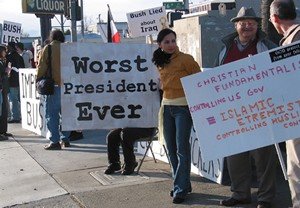
Can the USA continue to afford George W. Bush?

(picture by Gary Zimmerman)

Until recently, talk of ousting President George W. Bush has been very limited, coming mostly from radicals from the political left, groups supportive of anti-war causes (although some calls have come from members of the political right). For too long, impeachment has been deemed implausible. The arguments were that it would not happen with a Republican Congress, not with the president finishing his second term and certainly not while the country was at war.
But today impeachment isn't just a “looming carnival of the absurd”, a mirage in an uncertain horizon – it is a real possibility for 2007. The movement is growing louder by the day, creating a resonant echo that is rapidly taking root in public discourse. The issue was recently brought back to the spotlights by the March’s issue of Harper’s Magazine.
“Impeach Him,” reads the cover of the magazine, with an essay by Lewis H. Lapham to the title “The Case for impeachment: why we can no longer afford George W. Bush”. According to Harper’s magazine, on December 18 of last year, Congressman John Conyers Jr. (D., Mich.) introduced into the House of Representatives a resolution inviting it to form “a select committee to investigate the Administration's intent to go to war before congressional authorization, manipulation of pre-war intelligence, encouraging and countenancing torture, retaliating against critics, and to make recommendations regarding grounds for possible impeachment”. Despite the case of the National Security Agency's illegal surveillance of the American citizenry, which was making news by then, the request faced nearly complete silence, attracting little or no attention in the press and television, only some applause from the left-wing blogs and heavy sarcasm on the websites flying the flags of the militant right. When raised the question as to what he had in mind, and who did he intend to address, the congressman answered: “To take away the excuse that we didn't know. So that two or four or ten years from now, if somebody should ask - Where were you, Conyers, and where was the United States Congress, when the Bush Administration declared the Constitution inoperative and revoked the license of parliamentary government - none of the company now present can plead ignorance or temporary insanity, can say that - somehow it escaped our notice - that the President was setting himself up as a supreme leader exempt from the rule of law”.

Also in a public forum in New York City recently, journalists, lawyers, and political figures came together to discuss the case against George W. Bush. In fact, the case for the impeachment of President Bush is arguably the strongest in American history, apparently even comparatively more powerful than the impeachment proceedings of Andrew Johnson, Nixon and Clinton. The Center for Constitutional Rights (CCR) makes this amply clear in its recent book, a concise indictment of President Bush that lays out four clear legal arguments that point to impeachment as a necessary remedy for the gross violation of American Constitution. The Articles of Impeachment Against George W. Bush covers illegal wiretapping, torture, rendition, detention and the Iraq war. Even the Washington Post (claiming that "for some liberal pundits, it's payback time while for some conservative commentators, it's time for uncomfortable explanations") and the N.Y. Sun have brought out articles on the issue. However, some argue that this is not the right moment to go for impeachment, prefering to wait for a possible take over of the Congress by the Democrats, which would facilitate this at a later stage.

But it’s not only Bush that is being criticised, it’s all his team, whose misjudgments and mistakes have led to the deaths of thousands and a mess that continues three long years after Dick Cheney, Paul Wolfowitz, Donald Rumsfeld and others indicated that the war would be long done by now.

Read more on this issue at:
http://www.alternet.org/story/32977/
http://www.blogforamerica.com/archives/007626.html
http://www.conyersblog.us/archives/00000394.htm
http://impeachbushcoalition.blogspot.com/
http://en.wikipedia.org/wiki/Movement_to_impeach_George_W._Bush
http://www.bushlies.com/

20 mars 2006

As desagradáveis surpresas do Iraque...

No Publico de hoje 20 de Março, José Manuel Fernandes, director do jornal, escreve um artigo intitulado “Deve e haver da invasão do Iraque” e, consegue, contra todas as evidências chegar à conclusão que “a decisão [de invasão do Iraque] foi acertada, que o mundo e o Iraque estão melhor sem Saddam Hussein e que se estão a tirar lições do erros cometidos. O mundo continua perigoso, mas ter cedido seria pior”.

Certamente que o mundo, e o Iraque em particular, estão melhor sem Saddam Hussein. Mas há que perguntar, primeiro que tudo, “cedido” a quê? Em que é que Saddam e o seu regime, perfeitamente aniquilados militar e politicamente representavam uma ameaça para o mundo. Depois há que referir que as tais “lições que se estão a tirar” têm um preço humano demasiado elevado. Mas claro, são apenas iraquianos… outro tipo de reflexão não seria de esperar de JMF… conhecido pelas suas posições neo-conservadoras.
Pelo menos tem o mérito de reconhecer que “a invasão do Iraque (…) trouxe-me algumas surpresas desagradáveis”. Apenas é lamentável que não tenha tido na altura a visão geo-política para antever essas surpresas… é que quase tudo o que se passou era bastante previsível. Tem ainda a lata de escrever que “qualquer decisão política é tomada face aos dados conhecidos à época e, segundo, que existia então um grande consenso sobre as armas iraquianas.” (!!!). Quando se sabe perfeitamente (hoje, como se suspeitava já na altura) que a decisão de invadir o Iraque foi tomada com base em “evidências” e informações deliberadamente “fabricadas” e “inventadas” para servir o objectivo traçado pela administração Bush e já perfeitamente estabelecido de invadir o Iraque. Porque Bush julgava necessário na altura fazer alguma coisa para vingar o 11/9 e resgatar o orgulho, tornando-se num herói, o que lhe valeu, digamos, a reeleição em 2004... O que é evidente é que o Iraque não constituía na época nenhuma ameaça para a segurança regional e muito menos mundial. É óbvio que “o Iraque atraiu jihadistas de todo o Mundo” e contribuiu para reforçar a força e campo de actuação da Al Qaeda e congéneres, mas tudo isso era já por demais previsível. Tudo isso é bastante óbvio e consensual hoje, até mesmo nos Estados Unidos, onde 70% da população está hoje contra a guerra do Iraque e crê que foi um mau negócio para os Americanos (com algumas excepções, claro, como os fabricantes de armamento militar ou certas empresas que se instalaram no Iraque e enriqueceram, mas essa é outra história…). Mas O JMF e outros continuam a achar que não, que o mundo é hoje um lugar mais seguro, porque Saddam está na prisão. Mesmo se a História ainda não escreveu as últimas páginas sobre o Iraque, equivocam-se redondamente, pois o mundo não é hoje um lugar mais seguro (como o provam vários atentados cometidos um pouco por todo o mundo) e o Iraque não está melhor do que há três anos atrás.

Paz/ Frieden/ Peace


"In den Dünen sitzen. Nichts sehen
Als die Sonne. Nichts fühlen als
Wärme. Nichts hören
Als Brandung. Zwischen zwei Herzschlägen
Glauben: Nun
Ist Frieden
."

"Estar sentado nas dunas. Não ver
Senão sol. Não sentir senão
Calor. Não ouvir
Senão quebrar as ondas. Entre duas
Pulsações acreditar: Agora
Há paz."

Günter Kunert em/in "Erinnerung an einem Planetten" (1963)
(tradução para o português por João Barrento)

Quota mínima de 33,3% de representação feminina

No próximo dia 22 de Março o Parlamento português vota o projecto de lei do PS introduzindo a obrigatoriedade de uma quota mínima de 33,3 por cento de representação feminina em todas as listas eleitorais: Assembleia da República, Parlamento Europeu e autarquias. Espero que finalmente esta discriminação positiva venha a traduzir-se numa maior participação politica das mulheres na vida política portuguesa, no Parlamento e no Governo. Aliás penso que estas quotas deveriam ser alargadas a todos os níveis de governo, incluindo o nacional, os regionais, as Juntas de freguesia, etc.
A maior participação política das mulheres deverá assim complementar a já grande participação das mulheres na vida económica do país. Efectivamente, dentro da União europeia, a participação feminina na vida económica portuguesa é das mais elevadas (em % da população activa, % das mulheres que trabalha, mesmo participação das mulheres em cargos de direcção e gestão) logo depois dos países escandinavos, França e Reino Unido. Também segundo as estatísticas do PNUD (Programa das Nações Unidas de desenvolvimento) Portugal aparece relativamente bem no que diz respeito à participação feminina. Mas uma maior participação política deverá completar essa participação activa na economia, e a discriminação positiva só pode, quanto a mim, ajudar.

Esther Mucznik, num artigo no jornal Publico no sábado 18 de março, intitulado “A mola da roupa” (no comment…), diz o seguinte…"Se me perguntarem se eu gostaria de ver mais mulheres na vida política, eu direi, obviamente que sim. Se a sua presença permite melhorar a qualidade da democracia, como afirmou Maria de Belém Roseira, eu direi que não sei."

Não sabe??? Achará a senhora por ventura normal que num país em que mais de 50% dos habitantes são mulheres, apenas uns 12 ou 15% dos parlamentares sejam mulheres? ou no Governo? Então não será óbvio que o aumento da participação feminina na vida politica aumenta a qualidade da democracia, porque aumenta a representatividade da população na vida política? Não é isto lógico?... E se a Senhora Mucznik ficasse em casa a estender roupa, não seria melhor? Ou a contribuir para que a taxa de fertilidade ultrapasse os tais 1,4. Não será mesmo com feministas deste calibre que alcançaremos os níveis de participação feminina da Noruega ou Finlândia tão depressa...

Complot pétrolier? Qui fixe le prix du baril?


Le film Syriana lance la polémique sur le rôle supposé néfaste de la CIA dans le monde du pétrole. Le magazine Trends.be, dans son édition du 16 mars, prétend que Clooney et compagnie, avec son film anti-américan primaire "Syriana", rendent plutôt service à Bin Laden & co. Pour moi l’important est que le film montre comment certains intérêts politiques et commerciaux plus au moins cachés peuvent avoir une grande influence et démasquent un peu tous les jeux et la corruption derrière la scène, pour conquérir des marchés, garantir le contrôle, etc… Rien de neuf. Mais quand on voit les bénéfices colossales qu’ont eu les compagnies de pétrole les dernières années à nos dépenses, on ne peut que s’interroger sur les pratiques douteuses et aussi sur le rôle des gouvernements qui assistent passivement à ça…

Selon l’éditorial du magazine Trends.be par Amid Faljaoui, les américains auraient laissez faire leurs alliés du Golfe: "Faites ce que vous voulez en interne, vous pouvez maltraiter votre population, aliéner vos femmes, censurer la presse,... Mais de grâce, laissez votre pétrole couler à flot et à un prix raisonnable. Ah oui, dernière recommandation : soyez gentils avec Israël. Pour le reste, on vous fiche la paix."
Ils auraient constaté que cette politique de laisser-faire a été un fiasco, le 11 septembre 2001 en aurait été la preuve suprême, mais aussi la situation sociale explosive dans certains pays. Depuis lors, les Américains auraient compris "qu'on a beau ignorer un mauvais voisinage, celui-ci finit toujours par vous rendre visite". D'où leur volonté (maladroite, certes) d'en finir avec ces dictatures du Proche-Orient, qui pourraient alors devenir des alliés… Un peu simpliste peut être mais intéressant quand même comme thèse…Entre-temps trois ans se sont passés sur l’invasion américaine de l’Irak, et ce pays produit toujours moins de pétrole qu’avant la guerre. De quoi se dire que soit les Américains se sont trompés soit ils ont choisi la mauvaise stratégie.

17 mars 2006

IRAQ: Thank you NeoConMen

Mother Jones, a magazine from San Francisco, proposes some comics in its internet site, signed by Mark Fiore, as an answer to the question “Was the Iraqi war really worth”? In short, the message convened is that, three years after the invasion of Iraq, chaos was made possible thanks to the generous action of the NeoConMen. Many parade to say “thank you”: the democrats from Washington, military on the ground, the Iraqi people…

In the same Mother Jones magazine, James K. Galbraith (economics teacher at the University of Texas-Austin who has worked with the U.S. Congress) writes another article under the title “Withdrawal Symptoms”, where he confirms the chaotic situation in Iraq nowadays, analyses the beginning of a long, slow, painful retreat from Iraq and warns about the consequences of the American invasion. He argues whether the American are drawing the full and correct lessons from this disaster.


“[In Iraq] Oil production and energy production are below pre-war levels. Our reconstruction efforts have been crippled by the security situation. Only $9 billion of the $18 billion appropriated for reconstruction has been spent. Unemployment remains at about 60 percent. Clean water is scarce.… And most importantly, insurgent incidents have increased from about 150 per week to over 700 in the last year.… Since the revelations at Abu Ghraib, American casualties have doubled.”
“Bush and Cheney have done more than merely bungle a war and damage the Army. They have destroyed the foundation of the post-Cold War world security system, which was the accepted authority of American military power. That reputation is now gone. It cannot be restored simply by retreating from Iraq. This does not mean that every ongoing alliance will now collapse. But they are all more vulnerable than they were before, and once we leave central Iraq, they will be weaker still. As these paper tigers start to blow in the wind, so too will America’s economic security erode.”

He argues that the american should now face a deeper debate and start quite soon asking this question: “Now that Bush and Cheney have screwed up the only successful known model for world security under our leadership, what the devil do we do?”

According to Galbraith, the reality is that the Iraq war could not be won by a force of any size or by an expenditure of any amount. “Against determined opposition, occupations in the modern world cannot prevail. They haven’t for more than 60 years. The reason is that the basic economics of warfare have changed”. He justifies this with his “fundamental facts of wars of occupation”, which tell us that foreign military power cannot long prevail over the territory of a people — in this case, the Sunnis of central Iraq — who are prepared to resist it to the death. According to him, this does not necessarily mean that the new Iraq will collapse when the Americans leave, but if the American army cannot defeat the insurgency, he argues that the insurgents will have to be accommodated politically. Otherwise, the civil war which the American will leave behind will be even more brutal in their absence.

In another article the
Christian Science Monitor of Boston presents an Iraqi family and asks the question “Was it worth it?”. According to the article, the Methboubs, like most Iraqi families, feel a mix of frustration, disappointment, and hope in the face of daily violence.

Gimme back my butter!

Nowadays, and in the United States in particular, nothing is what it used to be... Yogurts, cheese, butter, creme fraiche go light, with less and less calories. Ham, prosciuto, chorizo lose fat, beverages lose sugar, drinks lose caffeine, coffee goes nescafé (beurk)... the wine loses the cork, salads lose their dressings, and they all lose taste, they all lose their soul. At the same time some vegetables and cereals go transgenic (fortunately not yet in Europe), animals get antibiotics, dioxines... and soon enough, H5N1 something viruses... Soon we'll have the choice between eating plastic food or nothing. So while we're not there yet, I want my butter back! and my french cheese, my Serrano, my designer mineral water, my cork, my Delta espresso (or illy ok) and my red bull with plenty of caffeine and ginseng and guaraná & whatever to keep me going...

16 mars 2006

Music: Pinkboy from Portugal


A compilação "Pink Boy presents TPC" foi apresentada na discoteca Lux em Lisboa, com Antalgic (live), Camarao & Dk (live), Pink Boy (dj set) e D-Mars (dj set).

"Pink Boy presents Tpc" é um duplo Cd com edição na bloop e que reúne alguns dos mais importantes e inovadores nomes da nova geração electrónica portuguesa. TPC com Pink Boy foi uma rubrica do programa de rádio LuxSagresFM, na Rádio Oxigénio, usada por Pinkboy, um dos DJ's residentes do Lux, para divulgar trabalhos inéditos de valores emergentes da nova cena electrónica e de outros com créditos já bem formados, como Camarao. A compilação reúne música inédita de gente como Camarao & DK, Double D Force, Pinkboy, Zentex, Antalgic ou Kaspar.

Mais um exemplo da inépcia dos governos portugueses

Segundo noticia o jornal PUBLICO, os pedidos de companhias aéreas em lista de espera para o Verão 2006 para o aeroporto da Portela em Lisboa aumentaram seis vezes. A ANA (empresa gestora do aeroporto) prepara um plano de "emergência" para responder ao aumento de novos voos no aeroporto, enquanto as obras de alargamento da capacidade da aerogare não estiverem concluídas, dentro de três a quatro anos!

Mas, como será possível ter-se chegado até aqui? Como é possível chegar a planos de emergência? Como é possível que não exista uma planificação e estudos de tráfego e de mercado feitos atempadamente? Quantos milhões de Euros mais se terão de perder para o turismo na zona de Lisboa e em Portugal, porque em Portugal só se fala e se perde o tempo a fazer estudos (que parece que servem para pouco), a deitar abaixo aquilo que os "outros" propõem, em vez de trabalhar colectivamente, em vez de fazer as coisas bem feitas, (neste caso as infraestruturas aeroportuárias) no seu devido tempo?

É que, se as coisas fossem feitas como deve de ser, em 2009 ou 2010, deveria entrar em serviço um novo aeroporto de Lisboa, e os cerca de 400 milhões de Euros previstos para as obras (de remedeio, porque são apenas isso) na Portela teriam sido evitados. Isto sim é má gestão, mau governo dos dinheiros públicos, por sucessivos governos em Portugal. E quem paga? O contribuinte português.

Segundo a notícia do Publico, o aeroporto de Lisboa tem em lista de espera 5786 pedidos de slots - 6 vezes mais do que os 835 pedidos para o mesmo período, no ano passado. Desses, uma grande parte (1857) provêm da TAP e da Portugália. Esses slots são particularmente importantes para a TAP e para a sua estratégia de expansão no mercado Brasileiro, que vai crescer novamente este Verão, e para a formação do tal hub para o Brasil em Lisboa. Mas entretanto as obras de melhoramento da capacidade da Portela só estarão totalmente concluídas em 2009!

E em Portugal queixam-se de falta de competitividade! Mas a competitividade é isso mesmo: saber prever a tempo, planificar e executar atempadamente, dispor das infraestruturas e dos serviços no momento justo em que existe a procura de mercado - antecipar o mercado. Para melhorar a produtividade e a competitividade não é preciso necessariamente reinventar a roda nem re-descobrir a pólvora, nem criar centros de altas tecnologias. É preciso fazer bem aquilo que podemos, sabemos e onde temos vantagens competitivas. E o turismo e serviços são certamente dos sectores onde devemos e podemos ser competitivos.

A esta velocidade o tal hub tão desejado para o Brasil irá para Madrid (onde um novíssimo terminal acaba de ser inaugurado), a TAP perderá a vantagem que tem, e depois, com a tão falada privatização da TAP, será fácil e tentador para a poderosa Ibéria controlá-la, para melhor dominar todo o mercado de ligação Europa-América do sul, tornando-se então a TAP apenas mais uma companhiazita regional. Mas entretanto, alguns bolsos receberão uns milhõezitos e todos ficarão contentes, enquanto o país fica cada vez mais periférico… uma espécie de reserva ecológica… mas alegremo-nos, pelo menos Lisboa terá bons ares, não poluídos, pelo menos não por aviões de ligações intercontinentais.

15 mars 2006

Portuguese movie: "A Costa dos murmúrios"


The portuguese movie "A Costa dos Murmúrios" (from 2004) has just come out in Brussels. If you have the chance, I recommend it.

It is the first fiction movie of Mozambique born Margarida Cardoso, 41, a director who has produced some successful documentaries in Portugal. With "A Costa dos Murmúrios", Margarida Cardoso goes back to Mozambique, setting the scene in the last years of a long and disastrous colonial war (end of the 60ies), in which Portugal lost itself, stubbornly trying to save a condemned empire. It tells the story of Evita (by the excellent Beatriz Batarda), who arrives in Mozambique to marry Luís, a maths student who is doing his military service there. Evita soon finds out that Luís is not the same anymore and that, perturbed by the war, had become a sad imitator of his captain, Forza Leal. The men leave for big military manoeuvres in the north of the country. Evita stays alone and in the despair of trying to understand what has made Luís change, seeks the company of Helena, Forza Leal’s wife. Submissive and humiliated, Helena is a prisoner in her own house. She reveals the dark side of Luís to Evita…Lost in a world that is not her own, Evita soon realises the violence of a colonial time close to its end. A time of war, of loss and of guilt.

The movie adapted one of the best books (“A Costa dos Murmúrios") by Lídia Jorge, one of the most famous contemporary portuguese writers. The novel, written in 1988, had sold more than 50,000 in less than a year and has been translated in seven languages. This is one of the first Portuguese movies (as the book) to revisit a complex and troubled time in Portugal’s History, which still remains nowadays silent and a painful wound. By adopting an intimate and original point of view, Margarida Cardoso was capable to give the movie a universal dimension.

14 mars 2006

The new Almodovar is here!


"VOLVER" - sinopis (from the website):
The movie displays three generations of women in Spain, Raimunda (Penélope Cruz) married to an unemployed worker, her teenager daughter (Yohana Cobo), her sister Sole (Lola Dueñas) who is an hairdresser, the mother (Carmen Maura) and the father of both, her aunt (Chus Lampreave). "Volver" is not a surrealist comedy, although it my look like that. The living and the dead "live" together in harmony, with hilarious and intenselly emotional scenes. "Volver" paints the portrait of a genuine, white, spontaneous, intrepid, fair and fun Spain...

I can only eagerly wait for the film to come out...

13 mars 2006

The Oscars

So "Brokeback mountain" did not make it to win the Oscar for best picture this year... but was that really a surprise? Ang Lee got his oscar for best director and that was already good enough - the picture won three oscars, which is already fine. Not that "Crash" was such a great movie, which it wasn't, but it's set in LA, about tolerance in LA, where the Academy comes from... Anyway, I guessed right all the actors' oscars... and except for the best film, there were no real surprises this year. In any case there is nothing exceptional about the oscars, although I have the feeling they're improving and opening up with the years. If not how could they have made so many nominations for a film like Brokeback, nominate palestinian film "Paradise Lost" for best foreign language film or give an oscar to political "activist" George Clooney? The oscars aren't anymore what they used to be and it's just good like that.

For those who have not seen the ceremony nor have had the chance to see "Brokeback mountain" yet, here is a short animated film, courtesy of my friend Sandrine, bunnybackmountain. N-joy!

02 mars 2006

Sociedade: crítica a artigo no Publico

Comentários a um artigo de JM Fernandes, director do Publico, se não me engano no dia 23 de Fevereiro.

Por razões históricas e óbvias, é compreensível e justificável, quanto a mim, que exista punição do negacionismo em certos países, como Alemanha e Áustria. Mas penso, embora não seja jurista, poderia existir criminalização em todo o lado. Não se pode fazer certas afirmações públicas sem apresentar factos que as justifiquem e validem. E muito menos negar o holocausto ou o extermínio arménio ou outras barbáries. Certas afirmações são um incitamento indirecto (e por vezes mesmo directo) à violência e à repetição de certos actos. Tem de haver responsabilização daquilo que um indivíduo afirma publicamente. E no caso do tal “historiador” inglês, Irving, ele não é tão idiota como parece, aliás participava num encontro de neo-nazis austríacos, ou seja… com intenções políticas claríssimas. Não confundamos isto com liberdade de expressão, trata-se de distorção de factos, negação de verdades históricas, ou seja, dizer mentiras deliberadamente com fins políticos óbvios. E como tal, em minha opinião, deve ser punido.

Talvez faça falta escrever mais cartas de protesto ao director neo-qualquer-coisa do Publico. As vezes não convém deixar passar em branco certos disparates. Porque para além de confundir as coisas, ele mete tudo no mesmo saco, segundo lhe convém. O Publico até é um jornal relativamente pluralista mas já seria tempo de ter um director à altura. Nunca é demais protestar e escrever, etc, aliás parece que se faz muito pouco em Portugal. E também não é de esquecer a pérola que é a última frase no artigo do Publico, em que cita um certo Edmund Burke: "Não é o meu advogado que me diz o que posso fazer, mas o que o meu sentido de humanidade, de razão e de justiça me diz que devo fazer." Burke não precisava de leis, mas de valores. À falta de valores, nós vamos multiplicando as leis. Os resultados estão à vista.” Efectivamente, os resultados da homofobia estão à vista cada dia que passa, ainda, em 2006. Veja-se o caso de Teresa e Lena, para quem, depois de toda a publicidade nos media, a vida não está fácil. Ou o assassínio de um travesti no Porto, caso bastante mal relatado no Publico. Tudo isso não pode ser aceitável em Portugal 30 anos depois (!!!) de uma revolução democrática!

É como quando se apelida o Parlamento europeu de “ridículo”, por aprovar uma resolução convidando os Estados-membros da União Europeia a aprovar legislação anti-homofóbica. Pois foi isso que foi escrito também no Publico há algum tempo por uma outra “iluminada” colunista, uma certa Teté (mas também no DN por um outro homofóbico de cuidado, um certo César das Neves).

A proposta do BE, para criminalização de actos homofóbicos, no Parlamento de Lisboa, vem apenas no sentido da proposta (aprovada por larga maioria) do Parlamento europeu. Logicamente que, meter a condenação do historiador inglês com a proposta do BE para a inclusão da homofobia como crime de ódio (para além do racismo, sexismo, anti-semitismo etc), no mesmo saco, só lembra a alguém que seja, no mínimo homofóbico (e neo-conservador, claro).

Não se pode quanto a mim deixar passar em branco este tipo de atitudes, e muito menos por um director de um jornal como o Publico, que tem responsabilidades. Crimes motivados por ódio a um grupo/colectivo de indivíduos - homossexuais ou judeus ou muçulmanos ou de uma cor qualquer, etc, devem ser punidos. E não se trata, em momento algum, de propor a criminalização da expressão de ideias. Sejamos claros e não demagógicos.

The new wave of mexican cinema


After the Golden Age of Mexican cinema in the 1930s and 1940s, since the 1990s, Mexican cinema engaged again in a process of creativity and artistic growth, clearly becoming the leading cinema movement in the Spanish-speaking world. Contemporary Mexican films like Como Agua Para Chocolate, Danzón, Cronos, La Mujer de Benjamín, Amores Perros, Y Tu Mamá También (which received an Oscar nomination), El Crimen del Padre Amaro and others have captivated audiences and critics alike, in Mexico and outside. Gael García Bernal, who acted in some of these movies, has emerged as the darling star of world cinema (see, for example, Pedro Almodóvar's La Mala Educación and Walter Salles's The Motorcycle Diaries). Mexico's most talented young filmmakers – including Alfonso Cuarón (Y Tu Mamá También, Harry Potter and the Prisoner of Azkaban), Guillermo del Toro (Cronos, Hellboy), and Alejandro González Iñárritu (Amores Perros, 21 Grams) – have also crossed the border to win in Hollywood.

But last year, at the Cannes Film Festival, Mexico was also well represented: Battle in Heaven or Batalla en el cielo, by director Carlos Reygadas, was one of the most provocative and debated films in the official competition. And Sangre, a first film by 27 year old Amat Escalante (who assisted Carlos Reygadas in Batalla en el cielo) was also noticed in the section "Un certain Regard". Both films show sex in the cinema and life in an unconventional (realistic?) way. Indeed some of these movies, in particular Amores Perros, Batalla en el cielo or Sangre, display a kind of crude, raw even brutal side of everyday life reality. They are certainly a mirror to Mexican society, displaying some of its contradictions and dramas, although they only seem to open a little window on Mexico presentday life. Currently this seems to be the trend in Mexican cinema, although it remains to be seen whether this can be considered a new wave, a new movement, or whether we will get to see other type of more optimistic Mexican movies.

Checkout the most recent films Batalla en el cielo and Sangre and judge for yourself. In any case, the New Mexican cinema is a movement to follow very closely and I will wait eagerly for the next film to come out in Europe.

Read more on mexican cinema: Mexican Cinema in the '90s

vazypointbe


Pour ceux qui habitent Bruxelles (ou y viennent souvent...), voici un site intéressant, toujours avec de belles photos et une agenda de suggestions intéressantes: vazy!

>> Coisa Ruim <<


O cinema português começa o ano fantasticamente: “Coisa Ruim" da dupla Tiago Guedes e Frederico Serra (argumento de Rodrigo Guedes de Carvalho), produzido pela Madragoa-filmes, é um dos primeiros filmes portugueses abertamente fantásticos. Foi o primeiro filme português a ter honras de abertura da competição internacional do FANTASPORTO (Festival internacional do filme fantástico do Porto), que teve lugar dia 24 de Fevereiro, no Rivoli do Porto. E em princípio deve estrear hoje, 2 de março, no circuito comercial português. “Coisa Ruim" conta a história de uma família lisboeta que recebe como herança uma casa numa pequena aldeia do interior. Com a casa, diz o povo, vem também uma maldição... Estou curioso, mas entretanto, os trailers e o site do filme são prometedores...
Ler a
entrevista aos dois realizadores no DN.

01 mars 2006

Love is urgent / É urgente o amor

É urgente o amor.
É urgente um barco no mar.

É urgente destruir certas palavras,
ódio, solidão e crueldade,
alguns lamentos,
muitas espadas.

É urgente inventar alegria,
multiplicar os beijos, as searas,
é urgente descobrir rosas e rios,
e manhãs claras.

Cai o silêncio nos ombros e a luz
impura, até doer.

É urgente o amor

é urgente permanecer.

Eugénio de Andrade "Urgentemente" / Antologia breve (1972)

[en]

Love is urgent.
A boat on the sea is urgent.

It is urgent to destroy some words,
hatred, loneliness, cruelty,
some complaints,
many swords.

It is urgent to invent joy,
multiply kisses, harvests,
it is urgent to discover roses and rivers
and bright morning skies.

Silence falls on the shoulders
and the light, impure until pain.

Love is urgent,
it is urgent to remain.

La nouvelle vague du cinéma portugais?

Si j'étais étranger et que je regardais quelques unes des dernières productions cinématographiques portugaises intéressantes, et surtout celles qui arrivent à l’étranger - p. ex. "O fantasma" et "Odete" de João Pedro Rodrigues, "Alice" de Marco Martins ou encore “Noite escura“ de João Canijo (Nuit noire, avec l'excellente actrice Beatriz Batarda) - je dirait que ça va très mal au Portugal, et dans la tête des portugais. Je leur conseillerais peut être d'aller voir un psi, en vitesse. Les films sont noirs, sombres, bizarres, même tordus.

Malgré cette première impression, il y a des choses intéressantes et nouvelles. Est ce une nouvelle vague? Je trouve João Pedro Rodrigues le plus intéressant des directeurs et ce n'est pas du à la thématique de ces films. Déjà son premier film "O Fantasma" m’avait surpris positivement. Il n'était pas facile de faire le deuxième film. "Odete" n'est peut être pas un film facile, il y a des moments mêmes irritants voire ennuyeux, mais pourtant c'est un film spécial, que l'on aime ou déteste. Un film un peu dérangeant, sur la transfiguration de l'amour, le transfert des sentiments, sur la solitude... servi par une actrice prométeuse, Ana Cristina de Oliveira (elle avait fait surtout de la pub et a gagné avec ce film le prix pour la meilleure interpétation au Festival Internacional de Cinema de Belfort - Entrevues) et servi par une bande son magnifique... donc selon moi, à voir absolument, si vous aimez le cinéma "différent". Par contre, si vous préférez les comédies "mainstream" et les films d’action type Hollywood, forget it…

Mais le succès a aussi touché un autre film, "Alice", le premier film de Marco Martins, qui a été mentionné par le magazine Les Inrockuptibles comme l'un des bons films de 2005.
Malheureusement ce succès à l’étranger (même si seulement dans des cercles restreins) ne suit pas un succès au Portugal. Les films portugais, avec quelques rares exceptions, ne restent pas longtemps en exhibition… et quand ils restent, ce ne sont pas toujours les plus intéressants.
En 2005, le succès du film "O Crime do Padre Amaro” ne cache pas le divorce du public face au cinéma portugais. Avec ce film le quota du cinéma portugais n’est monté qu’à 3,1% du total. Maigre… Selon une enquête effectuée par le Centro de Investigação em Comunicação Aplicada, Cultura e Novas Tecnologias de l'Université Lusófona (cité par le journal Publico), 45,9% des personnes questionnées ne se souvenait même pas du dernier film portugais vu. 24,2% ne regardait jamais des films portugais et 93,3% préfère voir des films étrangers. Le cinéma portugais est souvent jugé trop littéraire, voire théâtral, pas très émotionnel. O Crime do Padre Amaro a constitué un cas spécial en 2005: assez populaire (mais pas de très grande qualité, il faut le dire) qui, jusqu’au 8 février 2006 avait été vu par 372.541 spectateurs, devenant ainsi le film portugais le plus vu jusqu’à présent, dépassant "Tentação", de Joaquim Leitão (1997), qui avait été vu par 361.312 personnes.


Il faut dire aussi que, en 2005, même si le nombre total de billets de cinéma vendus a diminué de 7,5%, passant de 17 millions de spectateurs à 15,7 millions, au Portugal, le nombre de ceux qui ont assisté à des films portugais a augmenté de 2,0% en 2004 à 3,1% en 2005, passant de 335.586 à 462.118 spectateurs en 2005. Si le grand responsable a été "O Crime do Padre Amaro”, d’autres films ont suivi, en particulier “Sonho de uma Noite de São João” (film d’animation luso-espagnole) et “Alice” de Marco Martins, qui ont eu seulement 56.457 et 33.320 spectateurs, respectivement.

Liste des films les plus vus au Portugal en 2005:1º Madagascar 692.350 / 2º Harry Potter 514.024 / 3º Guerre des Mondes 505.359 / 4º Mr. & Mrs. Smith 432.626 / 5º Uns Compadres do Pior 400.271 / 6º Ocean"s Twelve 391.271 / 7º Star Wars III 352.584 / 8º Million Dollar Baby 319.136 / 9º O Crime do Padre Amaro 314.975 / 10º Chicken Little 305.970 / source: ICAM.

A suivre…